Convert $50 Lessons to $183.33/mo: Flat Rate Tuition for Music Studios

Flat rate tuition is a fixed monthly or term fee that covers a student’s reserved weekly lesson slot, regardless of how many calendar weeks fall in a given month. It works best for enrolled, weekly students and for teachers who want predictable revenue instead of income that swings with holidays and cancellations. If that’s your studio, the next move is simple: calculate your rate from your per-lesson fee and guaranteed lessons per year.
TL;DR:
- Students are typically guaranteed 44 to 48 lessons per year to account for holidays and teacher breaks, ensuring predictable monthly rates.
- The common flat monthly fee is calculated by multiplying the guaranteed lessons by the per-lesson rate and then dividing by 12, with a small margin added for fees or materials.
- Clear written policies on make-up lessons, cancellations, and vacation weeks are essential to prevent disputes and clarify that tuition reflects an annual average, not weekly attendance.
- Automatic recurring billing and setting a fixed due date streamline payments, while gradual transition strategies help retain existing students during the switch to flat rate tuition.
- Keeping detailed lesson notes and documentation helps justify charges, reduces disputes, and builds trust by providing families with transparent records of lessons and practice plans.
Table of Contents
- Why Teachers Use Flat Rate Tuition: Benefits and Trade-Offs
- How Do You Calculate a Flat Monthly Tuition Rate?
- What Studio Policies Do You Need to Document?
- How Should You Set Up Billing and Payment for Flat Rate Tuition?
- How Do You Move Current Students to Flat Rate Tuition?
- What Documentation Habits Make Flat Rate Tuition Easier to Defend?
- Allegro Music Studio: Running Flat Rate Tuition Without the Spreadsheet Chaos
- Where to Learn More or Run Your Own Numbers
- Sources
- FAQ
Why Teachers Use Flat Rate Tuition: Benefits and Trade-Offs
Flat rate tuition solves a problem every private teacher knows well: the five-week month, the holiday that wipes out two lessons, the student who cancels the morning of and leaves you unpaid for a slot nobody else could fill. Averaging that revenue across the year means your paycheck stops depending on the calendar.
The advantages practitioners report most often:
- Income stability. You get paid the same amount every month, whether it has four lesson weeks or five, and whether a family takes a surprise trip to Florida.
- Fewer no-shows. Reserved-slot billing tends to reduce last-minute cancellations because families have already committed financially, a pattern documented among teachers who moved to flat monthly tuition.
- Better practice habits. Students enrolled on a fixed schedule tend to show up more consistently, which reinforces the routine that actually builds skill.
- Simpler bookkeeping. One predictable line item is easier for parents to budget than a variable per-lesson invoice.
The trade-off is flexibility. Per-lesson pricing lets families pay only for what they use; flat rate asks them to trust an average. You lose a little pricing elasticity in exchange for a calendar that doesn’t rule your income.
Pro Tip: Explain averaging before you ever send an invoice. A one-line note like “your fee is based on 44 guaranteed lessons spread across 12 months, not the exact number of weeks in each month” heads off almost every “why am I paying for a short month” email you’ll ever get.
How Do You Calculate a Flat Monthly Tuition Rate?
Converting a per-lesson rate into a flat monthly fee takes three steps, and you can do the math on a napkin.
- Pick your guaranteed lessons per year. Most studios land somewhere between 44 and 48, which assumes 6 to 8 weeks off for holidays, illness, and teacher vacation. A studio running a tighter calendar might guarantee up to 52; a studio with generous breaks might drop to 40.
- Multiply guaranteed lessons by your per-lesson rate to get an annual tuition figure.
- Divide the annual figure by your billing period (12 months is most common, though some studios bill over 10 months to skip summer, or by academic term).
Here’s what that looks like in practice, using worked examples from Color In My Piano:
A 30-minute weekly lesson at $50 per session, guaranteed 44 times a year, comes to $2,200 annually. Billed over 12 months, that’s $183.33 a month. A 45-minute lesson at $65, same 44-lesson guarantee, runs $2,860 a year, or $238.33 a month. A 60-minute lesson at $75 comes to $3,300 annually, or $275 a month.
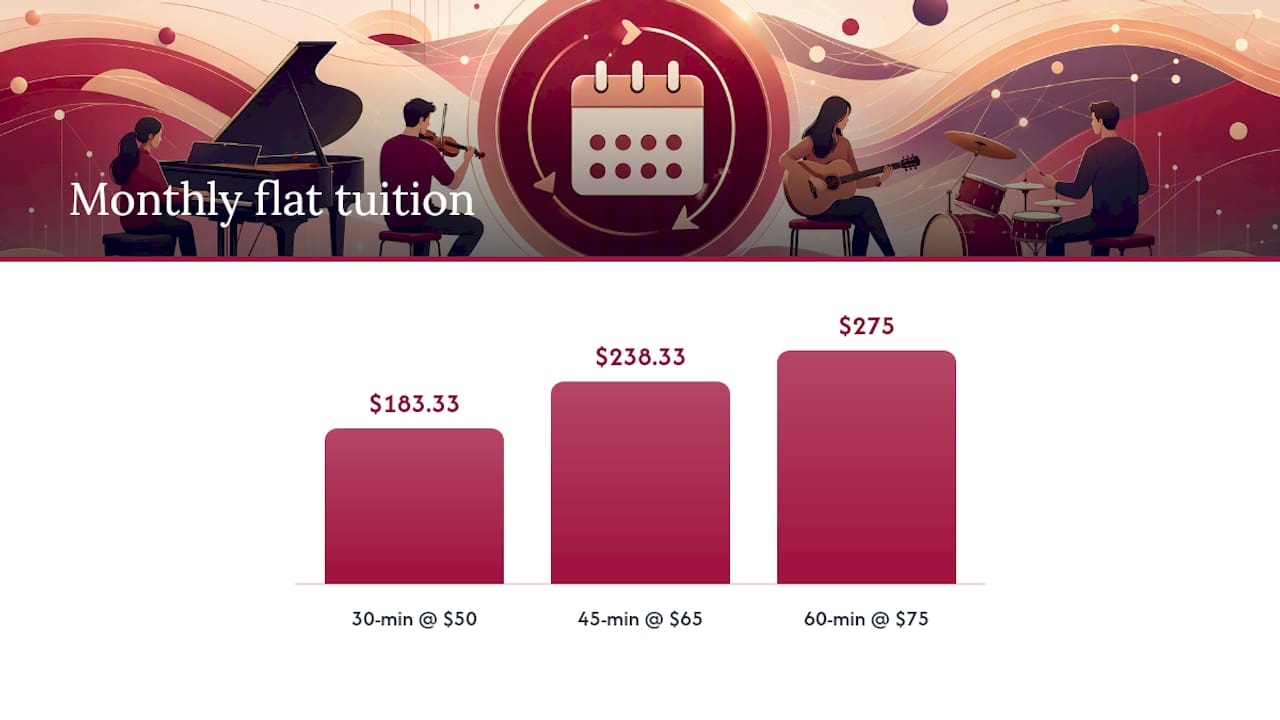
Those numbers are the floor, not the final invoice. Build in a small margin for credit card processing fees and consider folding a modest per-month allocation toward recital costs or materials so you’re not sending a surprise bill every spring. A quarter-point or two added to your monthly rate rarely triggers pushback, but it protects your margin all year.
What Studio Policies Do You Need to Document?
Flat rate tuition only works if your policies are written down and shared before the first invoice goes out. Verbal agreements are where disputes start.
The essentials every studio handbook should cover:
- Make-up lessons: Define what qualifies (teacher cancellation, documented illness) versus what doesn’t (a forgotten lesson, a scheduling conflict the family created), and set a notice window, commonly 24 hours, for students requesting a reschedule.
- Cancellation policy: Spell out whether missed lessons are forfeited, rescheduled, or credited, and whether that changes if the teacher is the one canceling.
- Vacation and flex weeks: State exactly how many weeks are built into your guaranteed-lesson count and remind families that tuition is averaged, not billed week by week.
- Withdrawal notice: A 30-day written notice period is standard and gives you time to fill the slot or adjust your schedule.
- Recitals and materials: Decide whether these costs live inside the monthly fee or get itemized separately, and say so in writing.
A sample line for your handbook might read:
Documenting this once, clearly, saves you dozens of individual conversations later. Practitioner guidance consistently points to written studio policy checklists as the single biggest factor separating smooth flat-rate transitions from messy ones.
How Should You Set Up Billing and Payment for Flat Rate Tuition?
Chasing payments eats more of your time than any other administrative task in a music studio, and flat rate tuition only pays off if collection is automatic.
- Turn on auto-pay by default. Recurring billing through a card processor or invoicing platform removes the monthly reminder emails entirely.
- Set a fixed due date, most commonly the 1st of the month, so families know exactly when to expect the charge.
- Choose your billing cadence. Monthly is standard and easiest to budget for both sides. Quarterly billing reduces your transaction fees and paperwork but asks families for a bigger lump sum. Term-based billing (aligned to school semesters) works well if your enrollment already follows an academic calendar.
- Decide how to handle card fees. Some teachers build the 2.5% to 3% processing cost into their rate; others add a small line-item surcharge or offer a discount for quarterly prepayment.
Before you send your first flat-rate invoice, run through this checklist:
- Select a payment processor that supports recurring billing.
- Enable auto-pay as the default option, not an opt-in.
- Test a refund or partial-credit transaction so you know the process before you need it under pressure.
- Build an invoice template that states the flat monthly amount, the guaranteed-lesson basis, and your cancellation policy in one glance.
How Do You Move Current Students to Flat Rate Tuition?
Switching an active roster from per-lesson to flat rate is where studios lose families if they rush it. Handle the timing and messaging well, and most students stay.
- Time it to a natural break. Announce the change at least 30 days before your next semester, term, or billing cycle starts, never mid-month.
- Communicate in layers. Send a written announcement explaining the “why” (predictability, fewer scheduling gaps), attach an FAQ handout addressing make-ups and vacations, and offer optional one-on-one conversations for families with concerns.
- Choose a transition path. Grandfather long-term students at their current rate for a set period, phase in the increase over two or three billing cycles, or offer one final pro-rated month under the old system before flipping the switch.
- Expect pushback and prepare for it. Most objections come from families who don’t understand the averaging, not from the price itself. A calm, written explanation of guaranteed lessons per year resolves the majority of concerns.
What Documentation Habits Make Flat Rate Tuition Easier to Defend?
Flat rate tuition rests on trust: families are paying for consistency, not a per-lesson receipt. That trust holds up better when every lesson leaves a paper trail parents can actually see. Turning weekly lesson notes into a parent-ready practice plan does more than look professional. It answers the question every flat-rate family eventually asks: “what exactly are we paying for this month?”
A saved weekly loop, notes captured once and reformatted automatically for families, also cuts down the time you spend writing individual updates or fielding “did we have a lesson last week?” emails. That’s less friction around your billing and fewer disputes about missed sessions.
— Dave
Allegro Music Studio: Running Flat Rate Tuition Without the Spreadsheet Chaos
Once your rate is calculated and your policies are written, the harder part is running the system week after week. A music studio platform can turn your lesson notes into parent-ready summaries, so every family gets a clear record of what happened and what to practice next, without you drafting a separate update by hand.
The same workspace can handle the billing side of flat rate tuition: invoicing, recurring payment links, and tuition tracking live alongside your lesson notes instead of in a separate app. When a parent asks why April’s invoice looks the same as February’s, you can point to both the policy language and the lesson history in one place. If you’re setting up flat rate tuition for the first time or converting an existing roster, Allegro’s studio workspace is built to handle the communication and payment side together. Start a trial and see how it fits your current billing cycle.
Where to Learn More or Run Your Own Numbers
- Color In My Piano walks through the full rate calculation with worked examples.
- Outside the Bachs covers practitioner results on income and attendance.
- Dansr’s tuition structuring guide offers sample policy language and flex-week planning.
Sources
- Why Piano Teachers Should Charge a Flat Monthly Fee for Lessons (And How to Calculate It) – Color In My Piano
- Why Music Teachers Who Charge Monthly Make More Money (and Have Less Drama) | Outside the Bachs
- How to Confidently Structure Tuition for Private Music Lessons
FAQ
What Is Flat Rate Tuition for Music Lessons?
It’s a fixed monthly or term fee that covers a student’s reserved weekly lesson slot, calculated from guaranteed lessons per year rather than the exact number of weeks in a given month.
How Many Lessons Should I Guarantee Per Year?
Most studios guarantee between 44 and 48 lessons, which builds in 6 to 8 weeks off for holidays and teacher breaks.
Is Flat Rate Tuition Better Than Per-Lesson Pricing?
Flat rate tuition trades some pricing flexibility for income stability and fewer no-shows; practitioner reports link it to higher, more consistent revenue compared to per-lesson billing.
How Do I Handle Missed Lessons Under Flat Rate Tuition?
Define make-up eligibility and notice periods in a written policy, and make clear that tuition is averaged across the year rather than billed per lesson attended.
Can Software Help Manage Flat Rate Tuition and Parent Communication?
Yes. A platform like Allegro Music Studio can pair invoicing and recurring payments with parent-ready lesson summaries, reducing disputes over what tuition covers.