Copy Ready Invoice Wording Examples and a Music Teacher Template

This article gives you ready-to-copy phrases and templates for line items, payment instructions, payment terms, late fees, and payment reminders. Late fees only hold up if you agreed to them in writing beforehand, so we cover that too. Near the end, you will find a short example built specifically for lesson-based businesses like music studios.
TL;DR:
- Clear payment instructions and proper documentation of late fees are crucial, but late fees are only enforceable if agreed upon in writing beforehand.
- Including detailed line-item descriptions with specific dates, scope references, and quantities reduces payment delays and avoids client questions.
- Accurate deposit math should show the full project cost first, then subtract deposits received to prevent confusion about the applied payment.
- Standardized invoice formats with consistent wording, payment terms, and reminder scripts can streamline collection and improve on-time payments.
- Small business owners, especially lesson providers, benefit from using integrated invoicing tools that track tuition, send payment links, and consolidate lesson notes.
Table of Contents
- What to include on an invoice: required fields and sample text
- Ready-to-copy invoice wording examples, organized by use case
- Sample invoice templates: compact finished examples to model
- How to write clear line-item descriptions and avoid back-and-forth
- Payment terms, late fees, and enforceability: how to word them
- How to send invoices and follow up: subject lines, short notes, and reminder scripts
- Practical example: invoice wording for lesson-based businesses
- Author checklist: final review before sending any invoice
- A practical option for lesson-based invoicing and tuition tracking
- FAQ
- Sources
What to include on an invoice: required fields and sample text
An invoice that gets paid on time usually has the same backbone, no matter the industry. Missing a field is one of the fastest ways to trigger a confused email from a client instead of a payment.
Start with your contact block and theirs. Write your legal business name, address, and a line labeled “Remit payment to:” followed by your preferred payment details. Add the client’s name and billing contact directly below.
Every invoice needs an invoice number and a date. A format like “Invoice #: INV-2026-001” paired with “Invoice date: June 2, 2026” keeps your records searchable and avoids duplicate numbering down the line.
- Due date or terms: spell out both the shorthand and the actual date, such as “Net 30 (Due: July 2, 2026).”
- Line items: each one needs a date or date range, a description, quantity or hours, unit price, and a line total.
- Subtotal and tax: show tax as its own line, labeled clearly, rather than folding it into the total.
- Deposits: list any prior payment as “Less: Deposit received” with the amount in parentheses.
- Balance due: the final number should stand alone and be impossible to miss.
Payment instructions close out the document; for example, you can learn client payment terms that actually get you paid faster to improve your invoicing process. A short line like “Pay by ACH: [routing and account number on file],” “Pay by check payable to [Business Name],” or “Pay online: [link]” covers the three most common routes without cluttering the page.
Ready-to-copy invoice wording examples, organized by use case
Different billing situations call for different phrasing. Below are templates you can paste directly into an invoice and adjust with your own numbers.
- Hourly services: “Website redesign, March 1 to 14, 2026, 22 hrs @ $150/hr = $3,300.00.”
- Fixed-price services: “Homepage redesign per SOW dated May 1, 2026, Phase 1: $3,500.00.”
- Deposit applied: “Less: Deposit received April 1, 2026 ($1,500.00)” followed by “Balance due: $1,800.00.”
- Reimbursable expenses: “Reimbursable expense, train fare for client site visit, receipt attached.”
- Sales tax line: “State sales tax (6.25%): $206.25,” shown as its own row beneath the subtotal, following the format recommended in LegalClarity’s invoice wording guide.
- Tax-exempt notation: “Tax-exempt per certificate #[number] on file.”
- ACH instructions: “Pay by ACH: routing #000000000, account #0000000000.”
- Check instructions: “Make checks payable to [Business Name] and mail to [address].”
- Pay-link instructions: “Pay online in one click: [payment link].”
- Flat late fee: “A $50 late fee applies to balances unpaid 10 days past the due date, per our signed agreement dated [date].”
- Percentage late fee: “Unpaid balances accrue 1.5% monthly interest after the due date, as outlined in Section [X] of our contract.”
Reimbursable expenses deserve their own line rather than getting folded into a service fee. If you’re billing mileage, reference the current IRS standard mileage rate so the client can verify the math themselves, a point LegalClarity raises directly in its invoice guidance.
Deposit math should always show the full project cost first, then subtract what was already paid. That sequence, confirmed by LegalClarity’s sales invoice guide, prevents a client from wondering whether the deposit was ever applied at all.
Pro Tip: Keep a saved folder of your five most-used line-item templates so you’re never rebuilding invoice wording from scratch.

Sample invoice templates: compact finished examples to model
Seeing the fields assembled together makes the wording easier to adapt. Here are four compact examples built from the phrasing above.
- Hourly invoice: Invoice #INV-2026-014, dated June 10, 2026. Line: “Copywriting services, June 1 to 10, 2026, 15 hrs @ $90/hr = $1,350.00.” Subtotal $1,350.00, tax $0.00, Balance due $1,350.00. Pay online: [link].
- Fixed-price invoice: Invoice #INV-2026-015. Line: “Brand identity package per SOW dated May 20, 2026 = $4,000.00.” Less: Deposit received May 20, 2026 ($2,000.00). Balance due: $2,000.00.
- Deposit/retainer invoice: Invoice #INV-2026-016. Line: “Consulting retainer, July 2026 = $2,500.00.” Less: Deposit received July 1, 2026 ($1,000.00). Balance due: $1,500.00.
- Recurring lesson invoice: Invoice #INV-2026-017. Line: “Piano lessons, student: Mia Chen, sessions June 3, 10, 17, and 24, 2026 = $240.00 (4 sessions @ $60).” Balance due: $240.00. Pay by ACH or pay online: [link].
How to write clear line-item descriptions and avoid back-and-forth
Vague descriptions are the single biggest reason clients delay payment. Compare “Design work” to “Homepage and contact page design per SOW dated May 1, 2026, 8 hrs @ $125/hr.” The second version answers every question before it gets asked.
A description that matches the client’s own records closes the loop fast. Use this checklist on every line:
- Include a specific date or date range, not just a month.
- Reference the scope document, contract, or SOW by date.
- State the quantity, hours, or units delivered.
- Show the unit price next to the quantity.
If you catch yourself writing a one or two-word label, stop and expand it. “Consulting” becomes “Strategy consulting call, May 14, 2026, 1.5 hrs @ $200/hr, per retainer agreement dated April 1, 2026.” That level of detail turns an invoice into a document the client can approve without a follow-up call.
Payment terms, late fees, and enforceability: how to word them
Payment terms only work when the wording is unambiguous. Net 30 means payment is due within 30 calendar days of the invoice date, Net 60 extends that to 60 days, and Due on receipt means payment is expected immediately, according to QuickBooks’ breakdown of invoice payment terms. Always pair the shorthand with an actual date: “Net 30 (Due: July 15, 2026).”

Early-payment discounts can speed up cash flow on larger invoices. The common format is 2/10 Net 30, meaning the client gets a 2% discount if they pay within 10 days, with the full amount due at 30 days. Place that line directly under the payment terms so it is not missed.
Late fees come in two shapes: a flat fee or a percentage charge, commonly cited as 1.5% monthly interest, but enforceability depends on whether the client agreed to the fee ahead of time, per LegalClarity’s guide to sales invoices.
A late fee is only enforceable when it was agreed to in a signed contract or terms of service before the work began. Adding a penalty after the fact, on an invoice alone, generally will not hold up.
Check your state’s rules before adding surcharges for credit card payments, since some states restrict or ban them entirely.
How to send invoices and follow up: subject lines, short notes, and reminder scripts
A clear subject line gets your invoice opened instead of buried. Use a format like “Invoice #INV-2026-014, Copywriting Services, Due July 2, 2026.”
Keep the email body short: “Hi [Name], please find attached invoice #INV-2026-014 for June’s copywriting work, due July 2. Thanks for your business.”
- First reminder (friendly): “Just a quick note that invoice #INV-2026-014 is due this Friday. Let me know if you have questions.”
- Second reminder (firm, past due): “Invoice #INV-2026-014 is now 10 days past due, with a current balance of $1,350.00 plus any applicable late fee. Please remit payment this week.”
- Final notice: “This is a final notice for invoice #INV-2026-014. Payment is required within 5 business days to avoid further action.”
Institutional billing systems often space these out on a weekly cadence and escalate tone with each notice, a pattern reflected in university billing policies like Jefferson’s student financial obligation page. That same staged approach works well for any small business chasing a balance.
Pro Tip: Ask for a one-line confirmation reply when you send an invoice (“Got it, thanks”) so you know it did not land in spam.
Practical example: invoice wording for lesson-based businesses
Music teachers and tutors can adapt every template above for recurring tuition. A clean example: “Piano lessons, student: Jonah Lee, sessions April 7, 14, 21, and 28, 2026, 4 sessions @ $65 = $260.00.” Add a parent contact line and a cancellation note like “Missed sessions without 24-hour notice are billed at full rate.”
Tying the invoice to a short practice summary from the lesson, rather than sending a bare number, cuts down on the “what was this for again” email entirely. If you teach lessons and want the invoice built into the same workspace as your notes, our studio workflow at Allegro shows how that pairing works in practice.
Author checklist: final review before sending any invoice
Before I send any invoice, I run the same five checks: do the dates match the work performed, does each line description match the contract or SOW, does the deposit math land on the correct balance, are the payment instructions complete enough that nobody has to ask a follow-up question, and were any late fees agreed to in writing beforehand. A consistent template across every invoice you send shortens the time it takes to get paid, because clients learn to expect the same format every month.
— Dave
A practical option for lesson-based invoicing and tuition tracking
If you teach lessons for a living, chasing tuition across texts, emails, and spreadsheets eats into time you’d rather spend teaching. We built Allegro Music Studio to keep invoicing, tuition tracking, and lesson notes in one workspace instead of three.
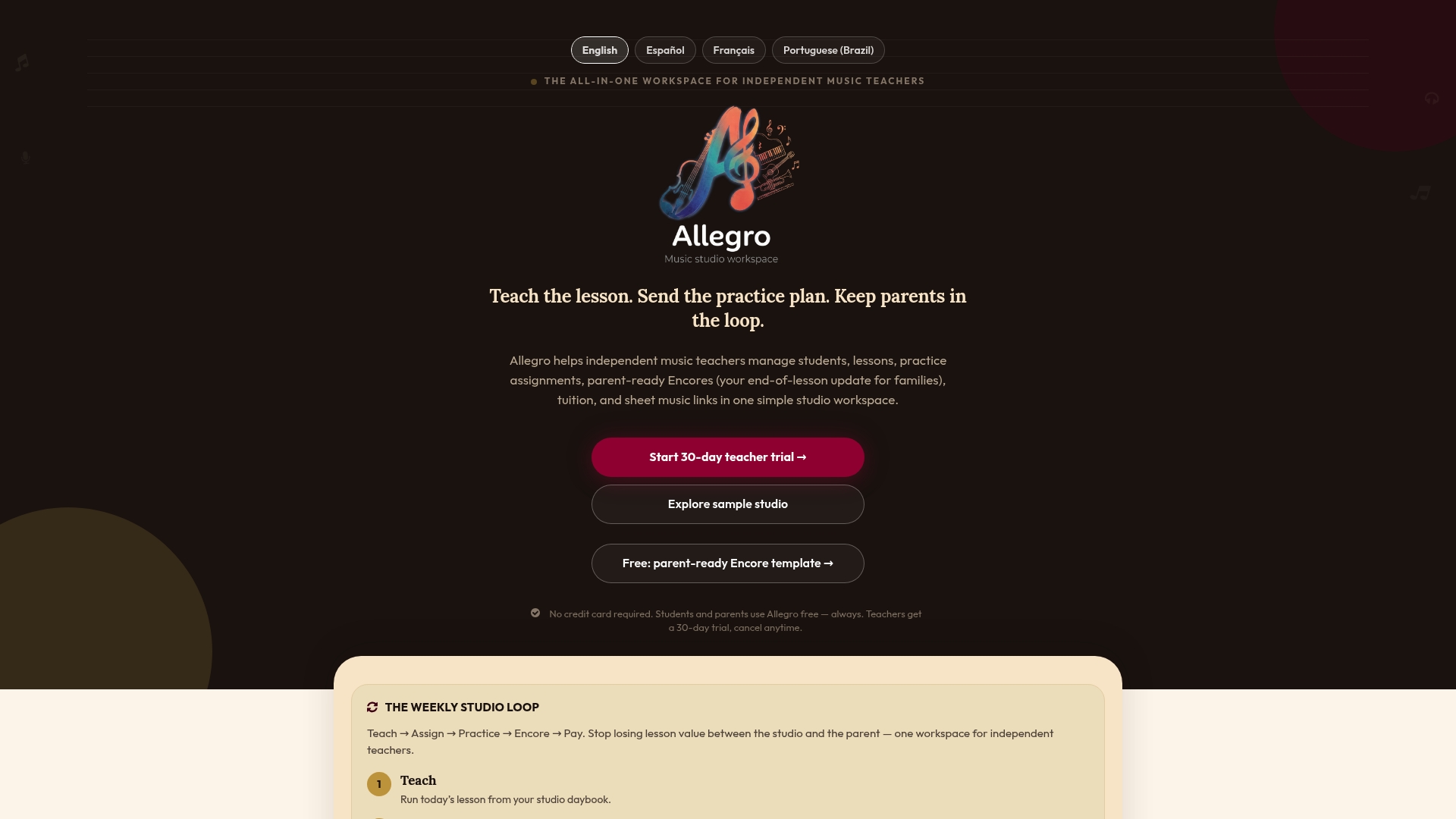
- Track tuition and send invoices with built-in payment links, so families can pay without a separate app.
- Turn lesson notes into parent-ready Encores that summarize progress and next steps.
- Keep student rosters, assignments, and billing history in a single view instead of scattered files.
Our Solo and Studio plans are built around exactly this kind of recurring, lesson-based billing. For pricing details and a closer look at what’s included, visit Allegro Music Studio and see which plan fits your studio.
FAQ
What is a good message to put on an invoice?
A good invoice message states the service, the billing period, and a thank-you line, such as “Thank you for your business, payment is due by [date].” Keep it brief and specific so the client can verify the work at a glance.
What are common invoice terms?
The most common terms are Net 30, Net 60, and Due on receipt, along with early-payment discounts like 2/10 Net 30, according to QuickBooks. Pairing the shorthand with an actual calendar date removes any ambiguity about when payment is due.
How do I write a simple invoice?
A simple invoice needs your contact information, the client’s contact information, an invoice number and date, itemized charges with quantities and rates, a subtotal, any tax or deposit adjustments, and a clear balance due. Add payment instructions at the bottom so the client knows exactly how to pay.
What do I write on an invoice?
Write the invoice number, invoice date, due date or payment terms, itemized line descriptions with dates and amounts, subtotal, tax if applicable, and the final balance due. Round it out with payment instructions, whether that’s an ACH number, a mailing address for checks, or a pay-online link.