Four Lesson Notes Examples Private Music Teachers Can Copy via Allegro

Every post-lesson note should give one clear action, a measurable success criterion, and a fast way to check progress. A useful note names what the student worked on, states exactly what “good” looks like, and tells the family what to notice in a line or two. Tools like specialized music teaching platforms build this structure into a workflow so the note becomes a practice plan and a parent update at once.
TL;DR:
- Clear, actionable lesson notes should focus on one practice action, a measurable success criterion, and a straightforward method to verify progress.
- Using templates and structured feedback methods ensures notes stay specific, consistent, and helpful for both student monitoring and parent communication.
- Short, focused practice assignments like element elimination or tempo building, with defined checkpoints, improve student progress and accountability.
- Digital platforms that automate converting notes into parent-friendly updates save time and foster better home practice engagement.
- Adjusting the note format for diverse learners involves shortening actions, using visual checks, and pairing written notes with audio or physical cues to support different needs.
Table of Contents
- Four copy-ready lesson notes examples from beginner to recital prep
- How to write effective lesson notes using feedback, feed up, feed forward
- Quick reusable templates and note fields to paste into your tracker
- How Allegro converts notes into parent-ready Encores and trackers
- Five practice assignment examples aligned to self-regulated learning
- One-page teacher checklist for consistent, actionable notes
- Adapting lesson notes for diverse learners and special education needs
- Common mistakes that quietly make lesson notes useless
- Digital tools and platforms for creating and organizing lesson notes
- What consistent lesson notes actually change in a studio
- Turn your lesson notes into Encores with Allegro Music Studio
- Sources
- FAQ
Four copy-ready lesson notes examples from beginner to recital prep
The fastest way to write a better note is to copy a good one. Each example below names the student level, then gives a practice action, a success criterion, and a way to check it.
Beginner piano, month two:
- Practice action: play the C major five-finger pattern hands separately, slow tempo.
- Success criterion: no finger substitutions and even rhythm.
- Check: three clean repeats in a row, no metronome yet.
Intermediate violin, shifting practice:
- Practice action: isolate the shift from first to third position in measures 9 through 12.
- Success criterion: no scratchy landing, in-tune arrival note.
- Check: record five attempts and count clean landings.
Advanced guitar, tempo building:
- Practice action: run the bridge section at mm=76, adding four clicks daily if clean.
- Success criterion: no buzzed notes, steady eighth-note feel.
- Check: metronome log with the tempo reached by Friday.
Recital prep, voice:
- Practice action: perform the full piece from memory once daily, no stopping for mistakes.
- Success criterion: complete the run-through even with small slips.
- Check: one voice memo per day, reviewed before the lesson.
Parent-facing Encore for the recital example: “This week’s goal: get comfortable performing start to finish, even with mistakes. Listen for one full run-through and cheer for the finish, not perfection.”
How to write effective lesson notes using feedback, feed up, feed forward
A note that only describes what happened rarely changes what a student does at home. Organizing notes as feedback, feed up, and feed forward gives teachers a repeatable structure that a review of feedback structures in music teaching recommends for connecting diagnosis to next steps. Research on post-lesson feedback frames this at the level of self-regulation: the note should help the student monitor and adjust practice, not just remember instructions.
Use this three-line template during or right after the lesson:
- What happened: name the specific passage and what you observed today.
- Where you’re headed: state the current goal in one sentence.
- What to practice: give one action, one success criterion, one check.
Two phrasing examples for the success criterion and check: “no missed shifts in the first eight measures, checked by recording one run-through” or “steady tempo at mm=80, checked by three repeats with the metronome on.”
Pro Tip: Write the check first. If you can’t describe how the student proves they met the goal, the goal is still too vague.
Quick reusable templates and note fields to paste into your tracker
Keep three short templates on hand and fill in the blanks during the lesson instead of writing from scratch each time.
- Teacher-internal note: Focus: [topic]. Why: [reason this matters now]. Practice steps: [one to two steps]. Tempo: [mm marking]. Check: [recording, repeat count, or metronome log].
- Parent-facing Encore: This week’s goal: [one line]. What to listen for: [specific sound or behavior]. How to encourage: one sentence a parent can say in under a minute, like “ask to hear the tricky measure three times.”
- Student reflection prompt: One line for the student to fill in after practicing, such as “today felt easy or hard because…”
A weekly studio workflow that separates these three fields keeps the teacher’s technical shorthand out of the parent update, which tends to confuse families more than it helps them.
How Allegro converts notes into parent-ready Encores and trackers
The workflow is simple: write a two or three line lesson note, convert it into an Encore, then send the update with a practice checklist and an optional audio or sheet music link. Some music teaching platforms centralize this so the same note that guides practice at home also becomes the message a parent reads in under a minute.

Teachers save time by writing once instead of drafting separate texts, emails, and practice sheets. Communication stays in one place instead of scattered across apps, and families get a consistent format every week.
Example Encore built from the recital example above: “Goal this week: perform the piece start to finish without stopping. Listen for one full run-through daily. A quick ‘that sounded confident’ after each try goes a long way.”
Five practice assignment examples aligned to self-regulated learning
Short, specific assignments work better than open-ended ones like “practice your piece.” Strategies such as element elimination, thoughtful repetition, and “make it musical” come from curricula built around self-regulated practice strategies, which organize practice into short, teachable tasks rather than vague reminders.
- Element elimination: isolate just the left-hand pattern in measures 5 through 8, ignore the right hand entirely, and check with three clean repeats.
- Thoughtful repetition: repeat the shift passage slowly five times, checked with a short recording and a count of clean landings.
- Make it musical: play the phrase with an exaggerated dynamic shape, checked by a 30-second recording reviewed before the next lesson.
- Rhythm isolation: clap the syncopated rhythm alone before adding pitch, checked by three accurate claps in a row.
- Tempo building: raise the metronome by four clicks only after two clean run-throughs at the current tempo.
Practice notes structured this way create an ongoing back-and-forth between teacher and student. A practice notes framework that asks students to set one weekly goal, rather than several loose reminders, tends to produce clearer follow-through at the next lesson.
One-page teacher checklist for consistent, actionable notes
Keep this nearby while you write notes so every one hits the same bar.
- Do: give a single focus, a single strategy, a measurable check, and a moment for the student to reflect.
- Don’t: write vague instructions like “practice more,” stack multiple focuses into one note, or skip the check entirely.
- Rubric: rate the prior week’s success criterion 1 to 5, where 1 means not attempted and 5 means fully met with the check confirmed.
Adapting lesson notes for diverse learners and special education needs
A student with attention difficulties, a processing difference, or a physical limitation often needs the same three-part structure, just adjusted in scale and delivery. Shrink the action to something achievable in a single short sitting rather than a full week, and make the success criterion visual or physical instead of purely verbal when that fits the student better, such as a sticker chart for repeats instead of a written count.
For students who read notation slowly or process language differently, pair the written note with a short voice memo restating the same three lines. A survey on parental involvement in independent music lessons found that parents help more when the note gives them a concrete, specific action rather than an open-ended instruction, which matters even more when a parent is also supporting a child with additional learning needs at home.
For nonverbal or minimally verbal students, replace the reflection prompt with a simple thumbs up, thumbs sideways, thumbs down system recorded by the parent. Keep the check method consistent across weeks so the student and family recognize the routine, since unpredictable formats tend to undo the benefit of a structured note for learners who rely on routine to stay engaged.
The core rule holds regardless of the learner: one focus, one way to know it worked, and a format the family can actually use without translation.

Common mistakes that quietly make lesson notes useless
The most common mistake is writing a note that describes the lesson instead of directing the next one. “Worked on the Bach piece today” tells a parent nothing about what to do differently before Thursday.
A second mistake is stacking too many focuses into one note. A note with five reminders gives the student nowhere to start, and most of it gets ignored by the next lesson. Pick one.
A third mistake is skipping the check entirely. Without a way to confirm the goal was met, either recording, repeat count, or metronome log, the next lesson starts from the same uncertainty as the last one ended on.
A fourth mistake is writing notes only for yourself. Technical shorthand like “mm=72, m. 34 shift” means nothing to a parent, and a note that never gets read never gets acted on. Separate your internal shorthand from the plain-language version families see.
A fifth mistake is treating the note as one-directional. Before the student leaves, have them repeat the assignment back in their own words. This catches misunderstandings on the spot instead of at the next lesson, when the week’s practice has already gone to waste.
Digital tools and platforms for creating and organizing lesson notes
Paper notebooks still work for some teachers, but they make it hard to search past notes, track trends across weeks, or share updates with a parent who was not in the room. A simple shared document or spreadsheet is a step up, letting a teacher keep a running log per student that both note-taker and family can access.
Purpose-built platforms go further by separating the teacher-facing note from the parent-facing summary automatically. Some platforms are built specifically around turning a lesson note into a practice assignment and a parent-friendly summary without retyping the information twice, which matters most for teachers juggling more than a handful of students each week.
Whatever tool you choose, look for three things: a place to log the success criterion separately from the general note, a fast way to send a short update to families, and a searchable history so you can see whether a student actually improved on a specific skill over several weeks rather than guessing from memory.
What consistent lesson notes actually change in a studio
Writing the same three-part note every week felt tedious at first, but the payoff showed up fast. Students started showing up already knowing what they’d worked on, and parents started asking specific questions instead of the usual “how’s it going.” Follow-through improved once families could see exactly what to listen for in under a minute. The biggest shift was accountability: when a student knows the check is coming, the practice itself gets more focused.
— Dave
Turn your lesson notes into Encores with Allegro Music Studio
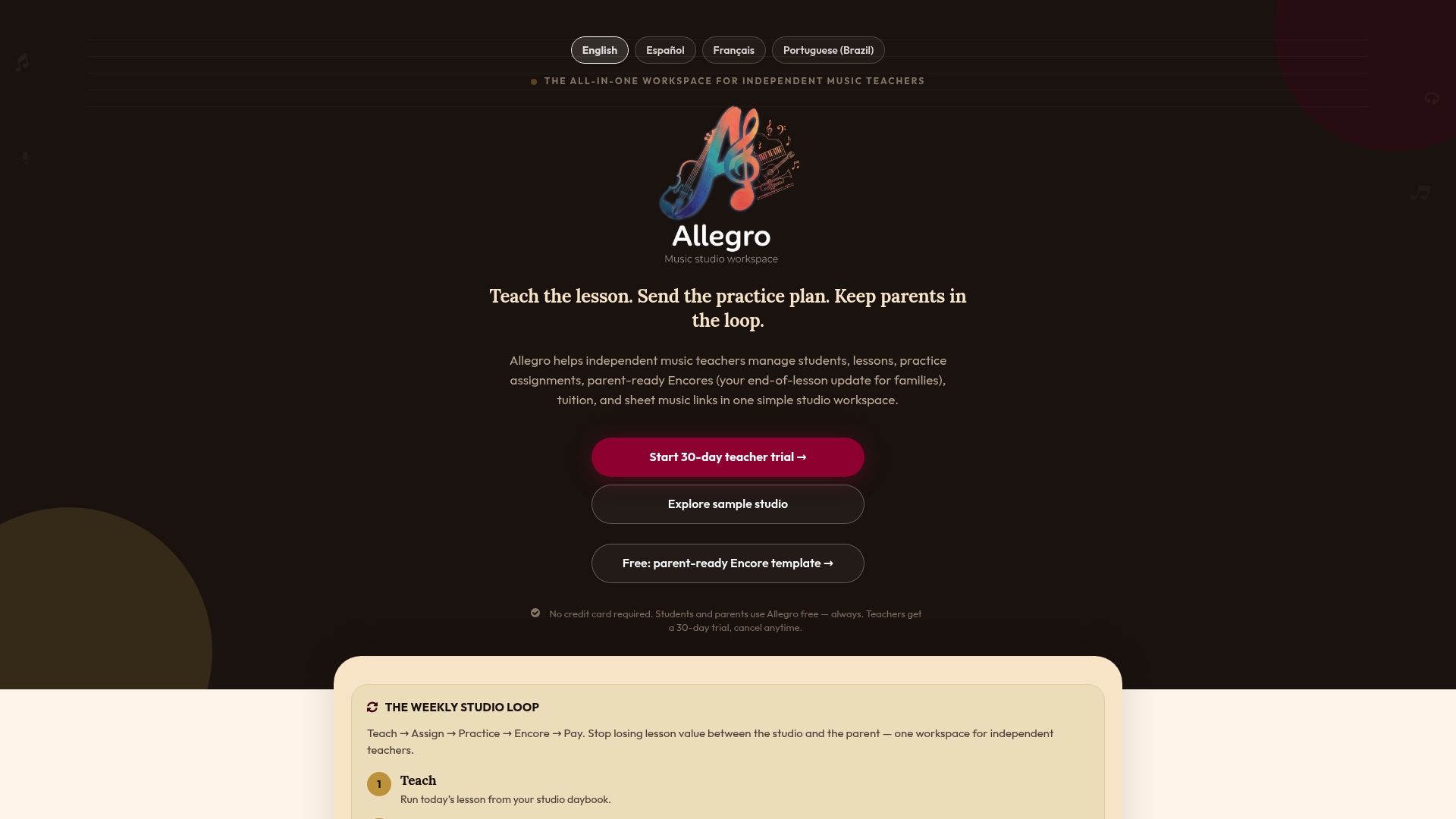
Writing three good lines per student is only half the job. Getting that update to a parent in a format they’ll actually read is the part that eats up a teacher’s evening. Certain music teaching platforms take the lesson note format and turn it into a parent-facing summary automatically, so the same three lines can serve as both a practice plan and a parent update.
| Plan | Price | Best for |
|---|---|---|
| Solo | Price available on request | Independent teachers starting out |
| Studio | $39 per month | Teachers managing a full roster and family communication |
Start a trial on the Solo or Studio plan and send your first Encore this week.
Sources
- Go home and practice: how shaping feedback to students can foster independent musicianship
- Feedback structures and implications for music teaching (review)
- How to Use Practice Notes — Practice Notes
FAQ
What should every music lesson note include?
Every note should include one clear practice action, a measurable success criterion, and a way to check progress, such as a recording, a repeat count, or a metronome mark. This structure follows the feedback, feed up, feed forward model recommended for music teaching.
How long should a parent-facing lesson summary be?
A parent-facing summary, sometimes called an Encore, should be short enough to read in under a minute, typically one or two lines. It should name the week’s goal and one specific thing the parent can listen for or encourage.
What is the feedback, feed up, feed forward method?
It’s a three-part structure that separates what happened in the lesson, where the student is headed, and what to practice next. A review of feedback structures in music education recommends this format to connect diagnosis directly to the next practice step.
How can I make practice assignments more effective?
Assign one specific strategy at a time, such as element elimination or thoughtful repetition, rather than a general instruction to “practice more.” Include a measurable checkpoint, like a metronome mark or a recorded run-through, so both student and teacher can confirm progress before the next lesson.
What tools help organize lesson notes and parent updates?
Options range from shared documents to platforms built specifically for music teachers. Allegro Music Studio, for instance, converts a short lesson note directly into a parent-ready Encore and a practice checklist within the same workspace.