Implement Today: Makeup Policies for Music Teachers, 30 Day Credits

Most studios succeed with a single clear policy: allow one reschedule or a lesson credit per missed lesson within a fixed notice window, otherwise the lesson is charged as given. The main paths are an individual reschedule, a group makeup clinic, a banked credit, or a strict no-makeup rule. A balanced version of this, paired with a 30-day expiration on unused credits, works for most independent studios and most families.
TL;DR:
- Rescheduling is limited to one-to-one, with a maximum of one per missed lesson, making it suitable mainly for small studios with flexible hours.
- Group makeups are more efficient when clustered around school breaks and are best for studios with at least five makeup requests per month.
- Credits expire typically after 30 days or at the end of the term, encouraging prompt scheduling and reducing backlog.
- Policies should specify a 24 to 48-hour notice window for routine cancellations, with longer notice for planned absences and automatic exceptions for illnesses.
- Using integrated management tools like Allegro Music Studio helps keep lesson notes, credits, and booking data in one accessible workspace, reducing admin workload.
Table of Contents
- Common Makeup Options Explained
- Eligibility Rules: What Counts as an Excused Absence
- Scheduling Mechanics: Windows, Priority, and Blackout Dates
- Payment, Credits, and What Happens After a No-Show
- Writing a Clear Makeup Policy: Templates and a Rollout Plan
- Tools That Cut the Admin Work Out of Makeups
- How Makeup Policies Affect Student Progress
- Making Makeup Options Work for Students With Disabilities
- Tracking Missed Lessons and Makeups Without Losing the Thread
- Keeping the Policy Fair Without Bending Every Time
- Where Allegro Music Studio Fits Into Your Makeup Workflow
- Sources and Further Reading
- FAQ
Common Makeup Options Explained
Rescheduling moves a missed lesson to another open slot that week or the next, usually capped at one reschedule per missed lesson so the calendar stays workable. It works best for small studios with flexible hours but breaks down fast once a teacher has more than a handful of students asking at once.
Group or clinic-style makeups gather several students who missed lessons into one session, often built around a shared skill like sight-reading or scales. They’re efficient for studios with five or more makeup requests in a given month and tend to work well clustered around school breaks, when attendance during clustered makeup weeks tends to be higher than scattered single-lesson makeups.
Lesson credits bank the missed session as a balance applied to a future invoice rather than a specific replacement slot. Strict no-makeup policies skip all of this: the lesson is paid for whether or not the student attends, and no replacement is offered.
- Reschedule: one-to-one replacement, limited to one per missed lesson, best for small rosters.
- Group makeup: several students combined into one clinic session, efficient at scale.
- Lesson credit: banked value applied to a future invoice, simple to track.
- No-makeup: lesson is paid regardless of attendance, no substitute offered.
Eligibility Rules: What Counts as an Excused Absence
A policy only works if everyone agrees on what counts as excused. An excused absence is typically illness, a family emergency, or a lesson the teacher cancels; an unexcused absence or no-show is a missed lesson with no notice or a cancellation that comes in after the cutoff.
- Excused: illness, emergency, or teacher-initiated cancellation, generally always eligible for a makeup.
- Unexcused: no-show or late cancellation past the notice window, generally not eligible.
- Gray area: planned events like family trips or school concerts, often eligible with enough advance notice.
Notice windows commonly run 24 to 48 hours for routine cancellations, with longer lead time expected for planned absences like vacations or recitals. Contagious illness is usually treated as an automatic exception even with short notice, since penalizing a sick child for staying home defeats the point of having a policy at all.
Pro Tip: Keep a one-line note in the student’s file every time you grant a discretionary exception, so the reason is documented and the next request gets judged the same way.
Scheduling Mechanics: Windows, Priority, and Blackout Dates
Makeup credits need an expiration date or they pile up indefinitely. Many studios cap validity at 30 days or the end of the current term, which keeps the backlog manageable and gives families a reasonable but finite window to use what they’re owed.
Booking priority usually goes to whoever requests first, with open slots posted somewhere visible so families can self-serve instead of waiting on back-and-forth texts. Recital season and major holidays are standard blackout periods: no new makeup slots are offered then, and any credit still open rolls into the next available week instead.
A simple workflow keeps this from turning into a scheduling headache:
- Log the missed lesson and the reason as soon as it’s reported.
- Confirm eligibility against the notice window and excused/unexcused rule.
- Offer available slots or add a credit to the student’s account.
- Set an expiration date and note it on the family’s record.
- Send a short confirmation once the makeup is booked or the credit is applied.
Payment, Credits, and What Happens After a No-Show
Most billing models fall into three camps: charge for the lesson but offer a credit toward a future session, charge with no makeup available, or refund only when the teacher is the one who cancels. Credits are easiest to track as a line item on the next invoice rather than a separate refund transaction, since banking lessons as credits rather than cash refunds keeps the bookkeeping in one place.
Fee language holds up better when it’s framed around value delivered, not punishment: “lessons are billed for the time reserved” is more defensible than “no refunds, ever.” For repeat no-shows, a graduated response works better than an immediate cutoff.
- First no-show: credit or reschedule offered as usual, no penalty.
- Second no-show in a term: credit offered but reschedule priority drops.
- Third or more: a direct conversation about fit before any formal fee kicks in.
Writing a Clear Makeup Policy: Templates and a Rollout Plan
A policy only works if it’s short enough that parents actually read it. Three versions cover most studios:
Generous: “Missed lessons may be rescheduled or credited with 24 hours’ notice. Credits expire 60 days after issue. Illness and emergencies are always eligible regardless of notice.”
Balanced (recommended): “One reschedule or credit is offered per missed lesson with 24 to 48 hours’ notice. Credits expire 30 days after issue or at term end, whichever comes first. Same-day illness is excused.”

Strict: “Lessons are billed for the time reserved. No makeups are offered for missed lessons except when the teacher cancels, in which case a credit is issued.”
Customization checklist before adopting any version:
- Set the notice window (24, 48, or 72 hours).
- Set the expiration rule (30 days, 60 days, or term end).
- Decide the booking method (self-serve link, text request, or email).
- List explicit exceptions (illness, emergency, weather).
- Pick one communication channel for all policy updates.
- Add the policy text to intake forms and the first invoice, not just a handbook nobody opens.
- Send a one-line reminder email when a family’s first missed lesson happens, pointing back to the policy.
- If you’re switching policies mid-term, announce it at least two weeks ahead, grandfather in any credits already banked under the old rule, and give one written example of how the new version applies.
Tools That Cut the Admin Work Out of Makeups
A visible lesson bank and open availability calendar remove most of the back-and-forth that turns makeups into a second job. When families can see open slots and their own credit balance without asking, the volume of “can I reschedule” messages drops sharply.
Automated reminders for booking confirmations and credit balances catch the scheduling conflicts a manual calendar misses. Allegro Music Studio is built around this: lesson notes turn into parent-ready summaries called Encores, and tuition tracking with booking links lives in the same workspace, so a makeup credit doesn’t get lost between a text thread and a spreadsheet.
- A lesson bank with visible balances cuts down on repeat questions from parents.
- Automated booking confirmations reduce double-booked or forgotten makeup slots.
- One synced ledger, whether a spreadsheet or an app, keeps credits and messages in the same place.
Pro Tip: Whatever system you use, make sure credit balances and message history live in one place, not split across a notebook, a text app, and an invoice tool.
How Makeup Policies Affect Student Progress
A missed lesson isn’t just a scheduling gap, it’s a gap in feedback at exactly the point a student needed correction on a new skill. When makeups are offered promptly, that gap closes before bad habits set in; when a lesson simply disappears with no substitute, the student shows up to the next session having practiced a mistake for two extra weeks.
Group makeup clinics carry a secondary benefit beyond just filling the gap: students who attend them often get exposed to peers working on similar material, which can reinforce concepts in a way a private lesson alone doesn’t. The tradeoff is that a clinic offers generalized instruction, not tailored to one student’s specific sticking point. It works better as a supplement to an individual reschedule than as a full substitute.
Strict no-makeup policies protect a teacher’s calendar and income, but they carry a real cost if a student’s absence was unavoidable: a sick week with no makeup can mean two or three weeks without correction on a skill, which is often enough for a student to lose momentum and disengage. The studios that see the least drop-off after a missed lesson are the ones that treat the makeup itself as an extension of instruction, not a scheduling favor, and get the student back in front of a teacher quickly rather than just crediting an account and moving on.
Making Makeup Options Work for Students With Disabilities
A rigid 24-hour notice window assumes a predictable household, and that assumption doesn’t hold for every family. A student managing a chronic condition, sensory sensitivities, or an unpredictable therapy schedule may need more flexibility than a standard policy allows, and treating every late cancellation the same way regardless of cause risks penalizing exactly the students who need lessons most consistently.
Practical adjustments that fit inside an existing policy rather than replacing it:
- Extend the notice window for students with documented recurring medical needs, rather than waiving the window entirely.
- Offer a remote or shortened makeup option when travel or a flare-up makes an in-person reschedule impractical.
- Build in one or two “no-question” flexible credits per term for students whose needs make last-minute cancellations more likely.
None of this requires a separate written policy. A single line, something like “accommodations for documented ongoing needs are available on request,” signals flexibility without turning the main policy into a negotiation for every family. The goal is consistency in how exceptions are granted, not identical treatment regardless of circumstance.
Tracking Missed Lessons and Makeups Without Losing the Thread
The biggest failure point in most makeup policies isn’t the rule itself, it’s that nobody can remember who’s owed what by week six of the term. A missed lesson that isn’t logged the day it happens tends to get disputed later, usually by a parent who remembers a credit differently than the teacher does.
The simplest fix is one running record per student: date missed, reason, eligibility decision, and expiration date, updated the same day the absence is reported. Whether that record lives in a spreadsheet, a notebook, or a dedicated app, the format matters less than the habit of updating it immediately rather than at the end of the month.

A monthly review catches credits approaching their expiration before families lose them, which prevents the awkward conversation about a forfeited lesson nobody flagged in time. Sending a short monthly summary, even just a line in an email, showing each family’s current credit balance keeps the record from becoming the teacher’s problem alone to track.
Keeping the Policy Fair Without Bending Every Time
Consistency beats flexibility here. The moment one family gets a quiet exception no one else knows about, the policy stops being a policy and starts being a negotiation, and the next parent who hears about it will expect the same treatment.
Discretion still has a place for genuine emergencies, but it works best when it’s logged and applied the same way twice in a row. Teachers starting out should adopt the balanced version on day one rather than drifting into strictness after getting burned, or generosity after feeling guilty. A written rule you actually follow protects both the income and the relationship.
— Dave
Where Allegro Music Studio Fits Into Your Makeup Workflow
Running a makeup policy by memory and text message is manageable with five students and unworkable with fifty. Allegro Music Studio keeps the pieces in one workspace instead of scattered across a notebook, a group chat, and a separate invoicing app.
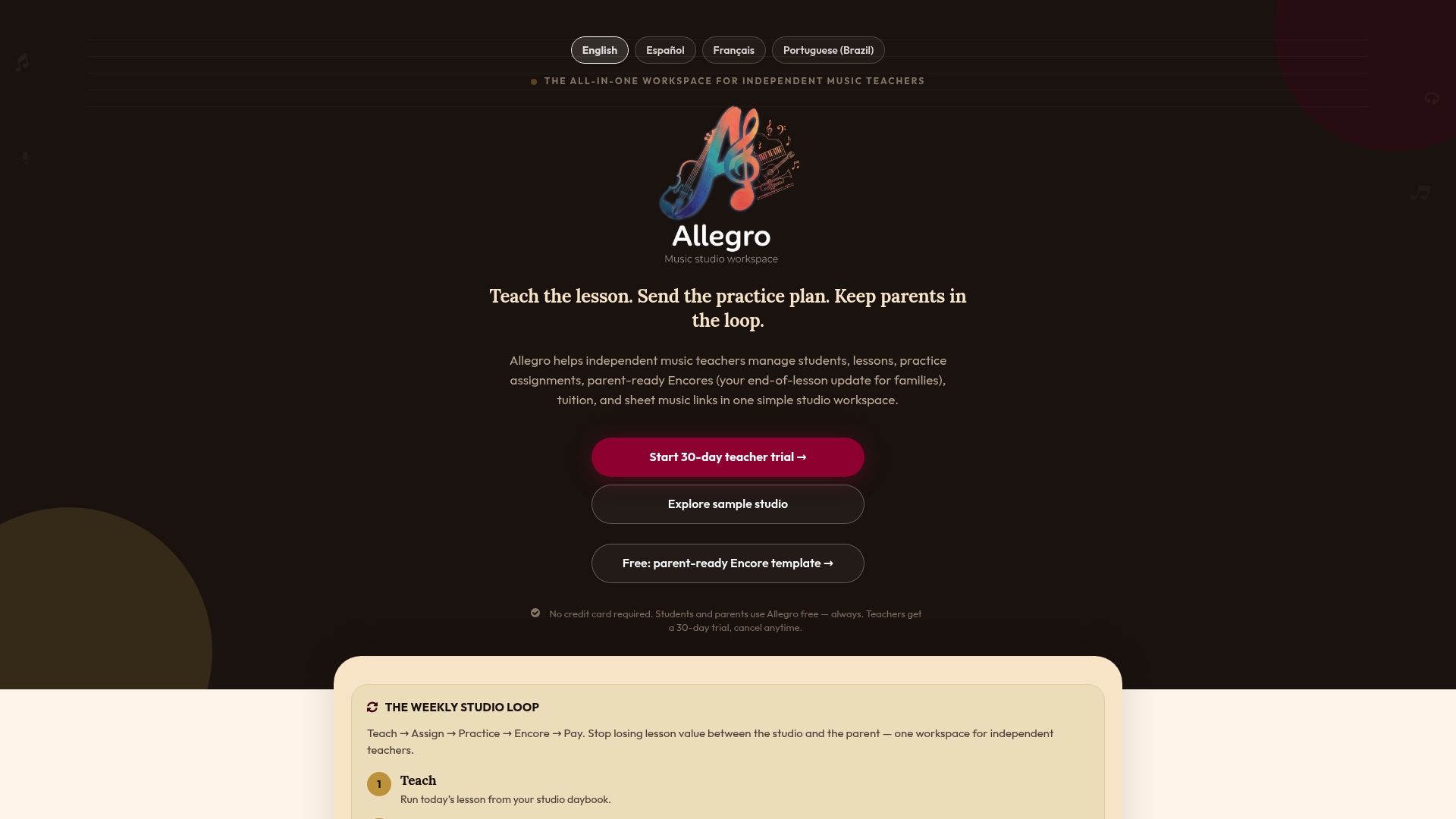
Lesson notes turn automatically into Encores, parent-ready summaries that show what a student worked on and what’s next, so a family knows exactly what a makeup lesson is replacing. Booking links and tuition tracking sit in the same place as those notes, which means a credit issued for a missed lesson is visible to the family the moment it’s applied rather than buried in a separate ledger.
- Lesson notes convert into Encores that parents can read without asking for a recap.
- Booking links let families see open makeup slots without a back-and-forth text thread.
- Tuition tracking keeps credits and invoices in one record instead of split across tools.
Allegro offers plans suitable for different studio sizes, with details and pricing available on the Allegro plans page.
Sources and Further Reading
- How to Manage Dance Studio Attendance (Without the Clipboard), StudioFlare, on attendance tracking and booking workflows.
FAQ
How many days’ notice should a makeup policy require?
Most studios ask for 24 to 48 hours’ notice for a routine cancellation to qualify for a reschedule or credit, with longer lead time expected for planned absences like vacations. Same-day illness is usually excused regardless of notice.
Should makeup lesson credits expire?
Yes, most policies cap credit validity at about 30 days or the end of the current term to prevent an unlimited backlog of unused credits. A clear expiration also encourages families to schedule the makeup promptly instead of letting it sit indefinitely.
What’s the difference between an excused and unexcused absence?
An excused absence covers illness, emergencies, or a lesson the teacher cancels, and it’s generally eligible for a reschedule or credit. An unexcused absence, like a no-show or a cancellation after the notice window closes, typically isn’t eligible for either.
Do group makeup lessons work as well as individual ones?
Group or clinic-style makeups are efficient for covering several missed lessons at once and work well clustered around school breaks. They’re a strong supplement to individual instruction but don’t fully replace the personalized correction a one-on-one reschedule provides.
Can Allegro Music Studio help track makeup credits?
Allegro Music Studio keeps tuition tracking, booking links, and lesson notes in one workspace, which makes it easier to see a family’s credit balance alongside their lesson history. It’s available through the Solo or Studio plan, which runs $39 per month.