Music Assessment Rubric That Turns Scores Into Practice Plans

A usable music assessment rubric is a short, standards-aligned checklist built around 3 to 5 observable performance domains, each with descriptive level criteria, so it works for both daily feedback and formal grading. Align it to the 2014 Music Standards through NAfME’s Model Cornerstone Assessments, and start with a compact template rather than an exhaustive one. The templates and workflow below show exactly how.
TL;DR:
- Discrete-component rubrics are ideal for assessing targeted technical skills, while holistic rubrics suit overall performance evaluations, and self-assessment rubrics promote student ownership.
- Fewer than five performance domains are sufficient for most classroom assessments, with pitch, rhythm, tone, expression, and ensemble being the core focus areas.
- Rubrics should be aligned with the 2014 Music Standards, emphasizing creating, performing, and responding, and adapted with grade-level language and local context.
- Descriptive scoring levels guide feedback effectively, with clear language describing auditory or visual performance qualities at each level.
- Using rubrics for practice planning involves translating low scores into specific, actionable tasks for students and sharing these with families to support targeted improvement.
Table of Contents
- 1. Three rubric approaches and when to use each
- 2. Core assessment domains and what to listen for
- 3. Aligning rubrics to NAfME and the 2014 Music Standards
- 4. Writing scoring levels and a sample rubric to copy
- 5. Using rubrics for feedback, self-assessment, and grading
- 6. Turning rubric results into practice plans and parent updates
- Teacher perspective: avoid these pitfalls and adopt these habits
- Put rubric feedback to work without the extra paperwork
- FAQ
- Sources
1. Three rubric approaches and when to use each
Not every assessment task calls for the same kind of rubric. Research on rubric construction identifies three dominant approaches, and picking the right one for the task matters more than how detailed it is.
- Discrete-component rubrics score isolated skills separately, such as pitch accuracy or bowing technique, and work best for targeted technical checks.
- Integrated-component (holistic) rubrics score a performance as a whole, making them a better fit for recitals, juries, or full-program evaluations where overall musicality matters more than any single skill.
- Self-reflection rubrics ask students to rate their own performance against the same criteria a teacher uses, which builds ownership of the learning process.
Analytic rubrics built with care can reach strong internal consistency, with reliability coefficients as high as 0.88 reported in one study, but that consistency depends on clear descriptors, not on how many domains you include. Pick one approach, pilot it on a single task, and revise before expanding it to a full unit.
2. Core assessment domains and what to listen for
Most classroom rubrics work better with fewer domains, not more. Five domains cover the vast majority of performance tasks without overwhelming a scoring sheet.
- Pitch and intonation: notes land in tune, shifts and large intervals stay accurate, pitch holds steady across a phrase.
- Rhythm and timing: tempo stays steady, subdivisions are even, entrances and cutoffs line up with the ensemble or accompaniment.
- Tone and technique: sound stays consistent across registers, posture and hand position support the instrument or voice, articulation matches the style.
- Expression and musicality: dynamics shape the phrase, phrasing breathes naturally, the performance communicates the piece’s character.
- Ensemble and listening: balance with other parts, response to a conductor or section leader, blend within the group.
For beginners, narrow the cues: “keeps a steady beat for four measures” rather than “maintains consistent tempo across tempo changes.” For advanced students, raise the bar to stylistic nuance and independence from the conductor.
Pro Tip: Cap any rubric at five domains. A sixth domain rarely adds information; it usually just adds scoring time.
3. Aligning rubrics to NAfME and the 2014 Music Standards
The 2014 Music Standards organize student work around three artistic processes: Creating, Performing, and Responding. The Model Cornerstone Assessments (MCAs) built on those processes give teachers a documented, field-tested structure rather than a blank page, and they are intended to be adapted by the classroom teacher rather than used verbatim.
A quick mapping example for a Performing task:
- Task: play a prepared solo excerpt for the class.
- Mapped domains: pitch/intonation, rhythm/timing, expression/musicality.
- Sample level descriptor (proficient): “Performs the excerpt with accurate pitch throughout, steady tempo with no more than one minor rhythmic slip, and clear dynamic contrast between phrases.”
Keep the underlying constructs from the MCA framework intact, but swap in your own repertoire, grade-level language, and local context. That is the adaptation the standard expects, not a departure from it.
4. Writing scoring levels and a sample rubric to copy

Numbers alone (“3 out of 4”) tell a student almost nothing about what to fix. Descriptive wording does the work instead: each level should describe what the performance actually sounds or looks like, not just how good it was.
A simple phrasing pattern across four levels:
- Level 4 (exemplary): consistent, independent, and stylistically convincing.
- Level 3 (proficient): mostly accurate with minor, infrequent errors.
- Level 2 (developing): inconsistent; errors interrupt the performance.
- Level 1 (beginning): frequent errors that prevent the piece from being recognizable.
A compact sample rubric, ready to copy into a handout or gradebook:
| Domain | Level 4 | Level 3 | Level 2 | Level 1 |
|---|---|---|---|---|
| Pitch/intonation | Accurate throughout | Minor, infrequent errors | Inconsistent accuracy | Frequent pitch errors |
| Rhythm/timing | Steady and precise | Mostly steady, minor slips | Noticeable tempo drift | Rhythm breaks down |
| Tone/technique | Consistent, controlled | Mostly consistent | Uneven across registers | Technique limits sound |
| Expression | Shapes every phrase | Clear in most phrases | Minimal dynamic shaping | Flat, no shaping |
Weighting domains equally keeps scoring simple; if one skill matters more for a given unit (say, rhythm in a percussion unit), double its point value rather than adding a separate weighting formula. Converting to a gradebook percent is then just total points earned over total points possible.
5. Using rubrics for feedback, self-assessment, and grading
The same rubric can serve three different purposes depending on when and how you use it.
- Use it formatively during rehearsal: a quick live checklist during a run-through gives a student one or two things to fix before the next attempt.
- Use it for peer or self-assessment: have students score a recorded playback against the rubric before you share your own score, which builds their ear for the same criteria you are listening for.
- Use it summatively at a unit’s end to document growth for a report card, portfolio, or jury.
Rater training matters even in a single-teacher classroom. Scoring a few exemplar recordings against your own rubric before grading live performances helps you catch inconsistent standards between the first and last student you hear.
Pro Tip: Score one recorded performance twice, a week apart, without looking at your first score. A big gap between the two means the descriptors need sharper wording.
6. Turning rubric results into practice plans and parent updates
A rubric score only changes a student’s progress when it becomes a specific instruction, not a filed grade. The gap between “scored a 2 on rhythm” and “practice clapping the eighth-note pattern in measure 12 for five minutes daily” is where most of the learning actually happens.
A practical pilot workflow:
- Score the performance against your rubric during or right after the lesson.
- Turn the lowest-scoring domain into one concrete practice task for the week.
- Share that task with the family in plain language, not rubric jargon.
This is the exact gap Allegro Music is built to close: lesson notes turn directly into practice plans, and Encores package rubric-based feedback into a parent-ready summary that tracks progress and names what to practice next, all in one place instead of scattered across texts and sticky notes.
Teacher perspective: avoid these pitfalls and adopt these habits
The biggest mistake in rubric design is not vague descriptors. It is length: a 10-domain rubric looks thorough and gets used twice before it is abandoned for a gut-feeling grade. Pilot a short version first, calibrate your scoring with a recording, and let students help write the descriptors for at least one domain. Treat the rubric as a draft you revise every year, never as a finished document.
— Dave
Put rubric feedback to work without the extra paperwork
Running a rubric is the easy part; turning the results into something a student acts on and a parent understands is where most teachers lose time. Allegro Music is built around that gap: attach rubric notes to a lesson, let them convert into a practice plan automatically, and send families an Encore that shows exactly what was scored and what to work on next.
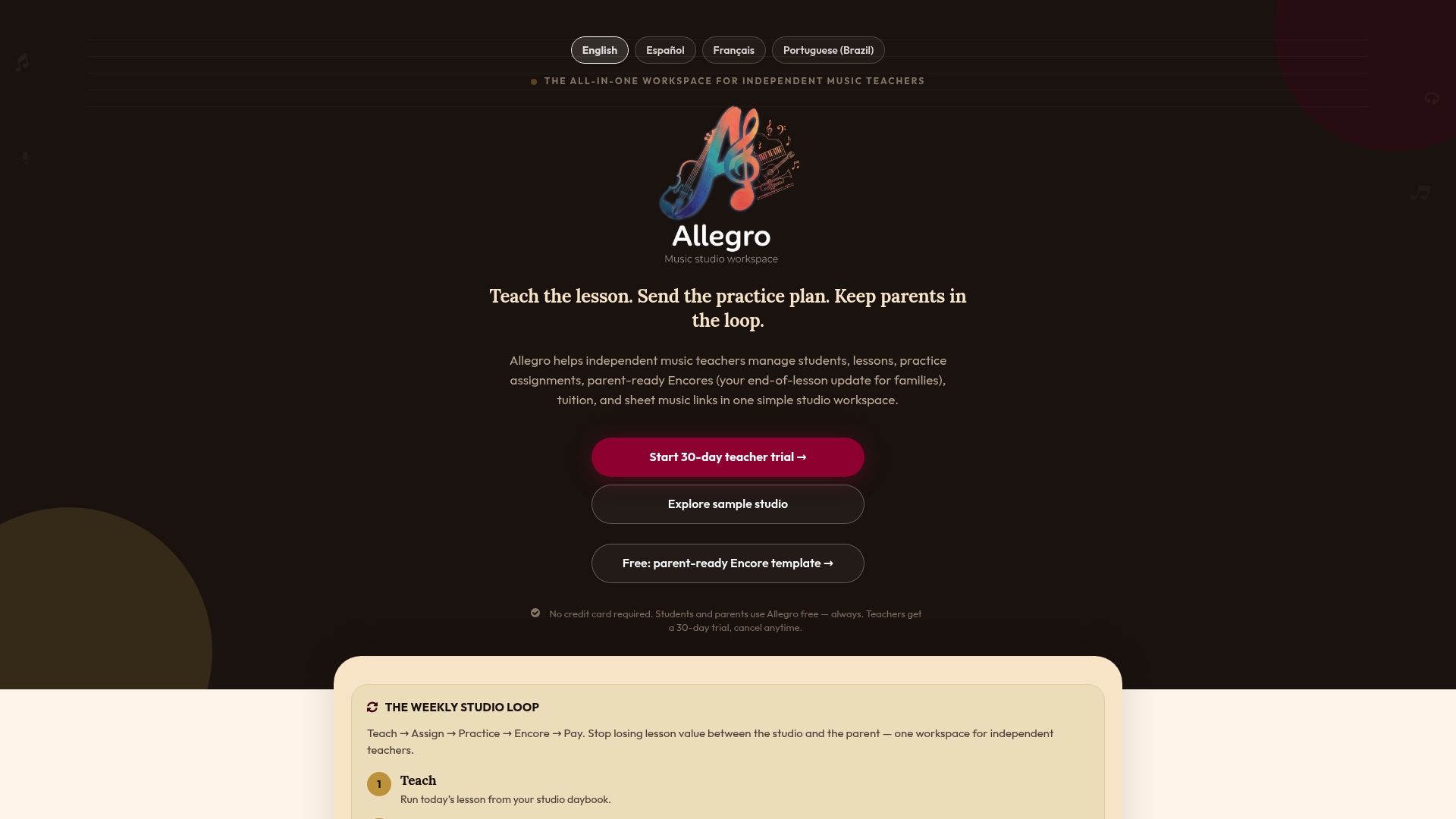
A simple way to pilot this: upload one rubric, score a single performance or recording, and send the resulting Encore to one family this week. If the workflow fits your studio, the Solo and Studio plans are built for independent teachers who want lesson notes, practice plans, and parent updates in one place.
FAQ
What is a music rubric?
A music rubric is a scoring tool that lists specific performance domains, such as pitch, rhythm, or tone, with descriptive criteria for each level of achievement. Teachers use it to score a performance consistently and to explain exactly what a student did well or needs to improve.
What are the 7 key elements of music?
Music theory commonly lists elements such as pitch, rhythm, tempo, dynamics, timbre, texture, and form, though definitions vary slightly by curriculum. For rubric purposes, most classroom assessments narrow this down to the 3 to 5 domains covered above, since scoring all seven separately becomes unwieldy.
Can ChatGPT create a rubric?
A language model can draft rubric language or suggest descriptor wording, but it cannot validate whether that wording measures what you intend to measure in your classroom. Any AI-drafted rubric still needs a pilot run and calibration against real student performances, the same way a human-written draft would.
Can you give me an example of a formative assessment for music?
A live checklist during a rehearsal run-through is a simple formative assessment: mark each domain on a short rubric as the student plays, then give one specific fix before the next attempt. Recorded playback paired with student self-scoring, as described above, works the same way and adds the benefit of the student hearing their own performance.
Sources
Start with NAfME’s Model Cornerstone Assessments for standards alignment, Carnegie Hall’s Link Up assessment materials for scripted task designs, and peer-reviewed rubric construction research for building or validating your own.