3 Step Parent Communication for Music Teachers: 1 1 1 Lesson Notes

Start with a short onboarding conversation, send a one-line lesson note after every session, add a weekly nudge with one concrete practice task, and close the month with a brief summary. That single routine, built from short lesson notes, weekly nudges, and monthly recaps, and resolves most of the friction between teachers and families. Templates and scripts for each piece follow below.
TL;DR:
- Sending brief, structured lesson notes within hours of the session helps parents recall progress and prepares them for next steps.
- Using the 1-1-1 format for updates ensures messages are clear and easily digestible for parents and students of all ages.
- Recording family preferences for communication channels and sticking to those methods improves consistency and reduces miscommunication.
- Following the 70/30 rule in practice encourages more active student engagement and fewer corrections from parents at home.
- Regularly documenting and escalating concerns with specific examples and clear next steps prevents conflicts from worsening over time.
Table of Contents
- First conversations and onboarding: a short agenda teachers can use
- Regular progress updates: the 1-1-1 lesson note model and cadence by age
- Formats and tools that actually work
- Turning research into action: practice structure and the 70/30 rule
- Handling difficult conversations: scripts and escalation steps
- Turning lesson notes into parent ready updates
- A quick experiment worth running
- How Allegro Music Studio fits this system
- Sources
- FAQ
First conversations and onboarding: a short agenda teachers can use
The first meeting sets the tone for everything after it, and it works best as a short, structured conversation rather than a freeform chat. Cover five things: the student’s goals, weekly practice expectations, how the family prefers to be contacted, attendance and payment policy, and what role the parent will play during practice at home.
A short onboarding script keeps this efficient:
- “What does your child hope to get out of lessons this year, and how much practice time feels realistic on a normal week?”
- “Would you rather get updates by email, text, or a quick voice note, and how often works for you: weekly or monthly?”
- “Here’s our attendance and payment policy, and here’s what I’d like from you during practice: mostly presence and encouragement, not correction.”
Once the conversation ends, write one dated sentence summarizing what was agreed and save it somewhere you can find it later. That single line becomes the reference point if expectations ever drift, and it takes less than a minute to write.
Regular progress updates: the 1-1-1 lesson note model and cadence by age
A lesson note works best when it is short enough to actually get read. The 1-1-1 format does that: one win from the lesson, one focus area, and one concrete practice task for the coming week.
- Send the lesson note within a few hours of the lesson, while details are fresh, in one to three lines.
- Send a weekly nudge that restates the single practice task in different words, so it lands twice before the next lesson.
- Send a monthly summary or short recording that shows progress over a longer stretch, which matters more to parents than any single lesson.
Cadence should flex with the student’s age. Pre-readers need the parent to receive and relay the note directly, since the student cannot yet read it themselves. Early readers can start reading simple notes with a parent alongside them. Teens often prefer being copied directly on communication, with parents looped in less frequently, which respects their growing independence without cutting parents out entirely.
Formats and tools that actually work
No single channel fits every family, so the smart move is to ask about preferences at onboarding and record the answer rather than guessing. Email suits families who want a written record they can revisit. Text works for quick nudges but gets lost for anything detailed. A 15 to 30 second video or voice clip showing a student’s progress tends to build more parent confidence than a long written note, since short multimedia updates reinforce what a lesson note only describes. App based lesson notes centralize everything in one place instead of scattering it across inboxes and text threads.
- Face-to-face: best for onboarding and difficult conversations, worst for routine updates.
- Email: best for detailed notes and monthly summaries, weak for urgent items.
- Text or SMS: best for quick reminders, weak for anything that needs context.
- Short video or audio: best for showing progress, weak as a stand-alone record.
- App-based notes: best for keeping a dated history in one place, weak if the family never checks the app.
Pro Tip: Ask “email, text, or app: which do you actually check first?” at onboarding, and write the answer into that student’s file so you never have to guess again.
Turning research into action: practice structure and the 70/30 rule
Good practice at home follows a shape, not just a length. An observational study of Suzuki students under 12 found sessions of 30 to 40 minutes, five to six days a week, with a consistent structure: warm-up, new skill work, and review. A significant portion of that time went to learning new material and review, with very little time lost to off-task behavior, giving teachers a template worth teaching parents directly.

Most lesson time should belong to the student, not the teacher. The 70/30 rule suggests teachers talk for about 30% of a lesson and design the rest around active student playing, which improves retention and builds independence. The same logic carries into home practice: parents get better results by asking questions than by giving correction.
Non-musical support matters more than musical expertise:
- Protect a quiet, consistent practice time and space so the student isn’t fighting for attention.
- Show curiosity instead of judgment, asking what the student is working on rather than critiquing tone or rhythm.
- Praise effort and repetition, not just clean final results.
Handling difficult conversations: scripts and escalation steps
Difficult conversations go better when they’re prepared, not improvised. Before raising a concern, gather your dated lesson notes, any recordings, specific examples, and a proposed next step.
- Missed practice: “I noticed practice has been light the last couple of weeks. Would a shorter daily task work better than a longer one a few times a week?”
- Payment issues: “I wanted to flag that this month’s invoice is outstanding. Can we confirm a date that works for you?”
- Parental micromanagement: “You’re clearly invested, which helps a lot. At this stage, I’d love for you to focus on encouragement and let me handle the technical corrections.”
When a pattern doesn’t improve after a direct conversation, escalate calmly: document everything with dates, propose a focused one-month plan with a clear checkpoint, and schedule a follow-up meeting rather than letting frustration build unspoken.
Turning lesson notes into parent ready updates
A simple three-step workflow keeps notes from disappearing into a pile of unread texts: capture the lesson note right after the session, convert it into a specific practice task, then turn that into a short update the parent can actually read. Some music studio management platforms structure this as lesson notes that become practice plans, which then become parent-ready summaries tracking progress and what to practice next.
Dated, concise notes matter because they remove ambiguity later. If a payment dispute or a practice disagreement comes up months down the line, a short dated record settles it faster than memory does.
- Lesson note: what happened today, in one to three lines.
- Practice plan: the single task drawn from that note.
- Parent update (Encore): a plain-language summary a non-musician parent can act on.
Teachers without software can run the same workflow manually with a shared folder or calendar and a templated note they copy and fill in each week.
A quick experiment worth running

Running this system for a year changed how quickly parents trusted what was happening in lessons, mostly because they stopped having to ask. The clearest sign it works is quieter: fewer confused check-in messages, not more praise.
Try this for one week: send the 1-1-1 lesson note after every session, nothing else added, and track how parents respond. Most teachers notice the tone of parent messages shift within days.
— Dave
How Allegro Music Studio fits this system
Allegro Music Studio builds the workflow above directly into a teacher’s routine: lesson notes become practice plans, and practice plans become Encores, parent-ready summaries that show progress and next steps without extra typing. It’s built for independent teachers who want the 1-1-1 model running automatically instead of assembled by hand every week.
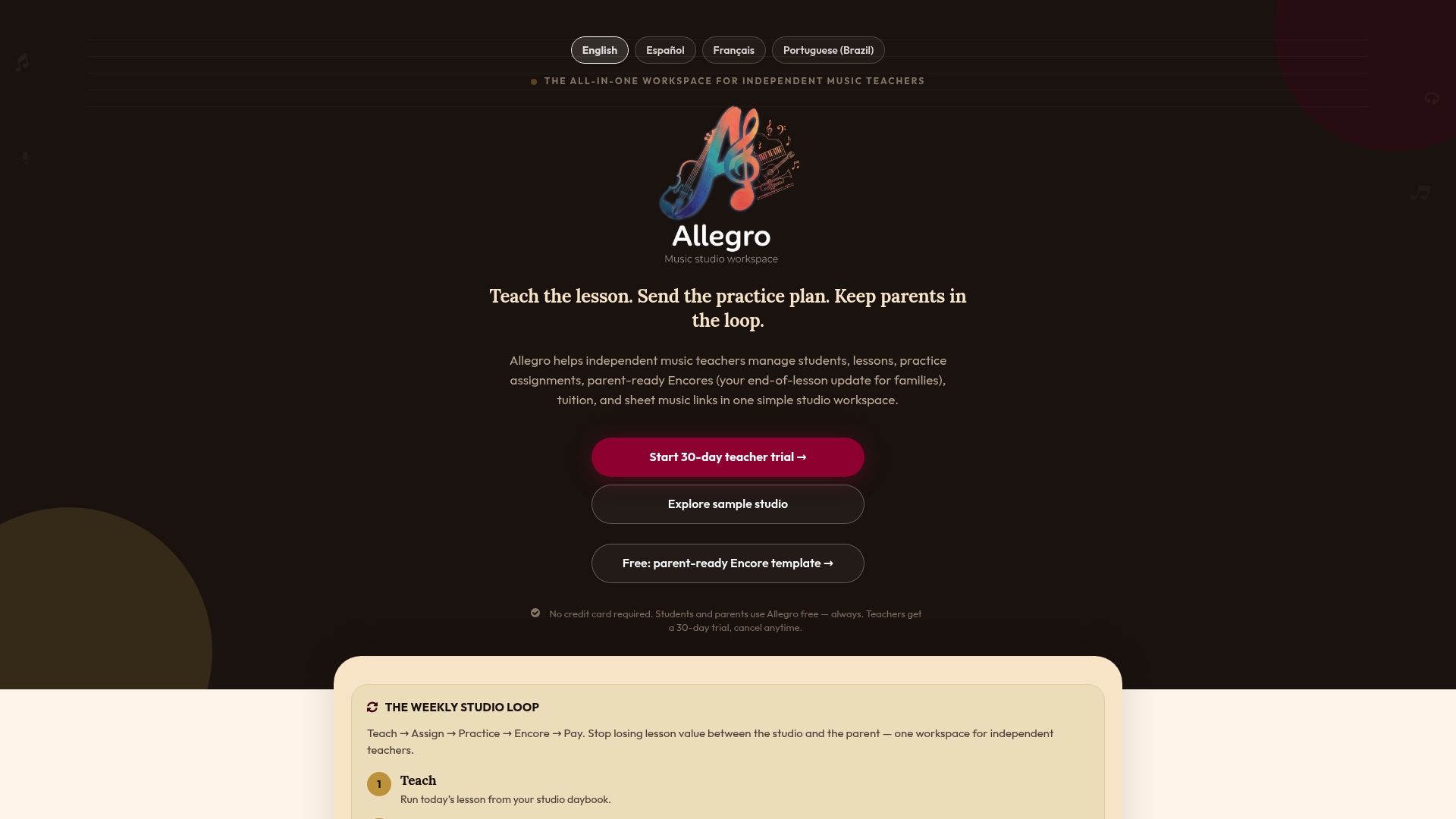
Teachers juggling more than a handful of students benefit most, since the time saved on writing updates compounds every week. Explore the Solo and Studio plans to see which fits your studio size, with Studio priced at $39 per month.
Sources
- Parent as home teacher of Suzuki cello, violin, and piano students: observation and analysis of Suzuki method practice sessions
- Teacher-parent communication strategies to start the year off right | Edutopia
- What is The 70/30 Rule in Teaching? | CTC Training
FAQ
What is the 70/30 rule in teaching?
The 70/30 rule means teachers talk for roughly 30% of a lesson and design the rest around active student engagement. In music lessons, that translates to more playing time and fewer long verbal explanations.
How can I communicate effectively with a difficult parent?
Prepare before the conversation with dated lesson notes and specific examples rather than general impressions. Use calm, specific phrasing that names the concern and offers one concrete next step, such as a shorter daily practice task or a follow-up meeting in a month.
What should a daily music practice session look like?
A well-structured session follows a warm-up, then new skill work, then review of familiar material. Observational research on Suzuki students found this structure common in sessions lasting 30 to 40 minutes, five to six days a week.
What are the most common ways teachers communicate with parents?
The most common formats are in-person conversations, email, text or app-based lesson notes, and short videos or voice clips showing progress. Short multimedia updates tend to build parent confidence faster than long written notes, according to classroom communication research.