Credit Card Fee Policy for Music Teachers: Rules and Wording

A credit card fee policy is a short written rule that tells families how card payments work in your studio and whether you pass processing costs on to them. For most independent teachers, the safest and simplest policy is to build processing costs into your tuition and say so plainly. If you do add a card surcharge, the card networks cap it, require advance notice and a separate line on every receipt, and a few states restrict it or ban it outright.
This guide walks through what a surcharge is, what the limits are, how to word the policy for parents, and how to avoid the awkward conversations that fee surprises cause.
TL;DR
- A surcharge is an extra fee added when a customer pays with a credit card. It is not the same as a convenience fee or a cash discount.
- Visa caps surcharges at the lower of the card’s merchant discount rate or 3%. Mastercard’s cap is the lesser of your acceptance cost or 4%.
- Debit and prepaid cards cannot be surcharged, and some states restrict or prohibit surcharging, so check your state first.
- You must notify your payment processor at least 30 days ahead, disclose the fee before payment and show it as its own line on receipts.
- Many teachers skip surcharges and set one clear tuition price, then put the card policy in the studio policy and on every invoice.
Table of Contents
- What a credit card fee policy covers
- Can you legally charge a credit card fee?
- Four ways to handle card fees in your studio
- Sample credit card fee policy wording
- Telling parents about the policy
- Common mistakes to avoid
- Our perspective
- Put your payment policy to work with Allegro
- Frequently asked questions
- Sources
What a credit card fee policy covers
Every time a parent pays tuition by card, your processor takes a cut. A fee policy answers three questions in advance:
- Which payment methods do you accept?
- Does a card payment cost the family anything extra?
- What happens when a payment fails or is disputed?
Put the answers in the same document as your tuition due dates, late fee and make-up rules. Families read a studio policy once at enrollment and come back to it when money is involved, so clarity there prevents most disputes.
Surcharge, convenience fee, cash discount and dual pricing
These four terms get mixed up, and the difference matters for legality.
| Term | What it means | Typical use in a studio |
|---|---|---|
| Surcharge | An added fee when a customer pays with an eligible credit card, meant to offset processing costs (Venable) | A percentage added to tuition paid by credit card |
| Convenience fee | A fee tied to a particular payment channel, such as paying online or by phone | Rare for private lessons |
| Cash discount | A reduction from the regular price for paying cash or another low-cost method | Lower tuition for check or bank transfer |
| Dual pricing | Showing a cash price and a card price side by side | Two tuition figures on the rate sheet |
The labels are not interchangeable. A fee that works like a surcharge but is called something else can still be treated as a surcharge by the card networks, so word it for what it is.
Can you legally charge a credit card fee?
Surcharging credit cards is not prohibited under federal law, but it is subject to state laws and card brand rules (Venable). That means three layers of rules apply at once: federal law (which leaves it open), your state, and the network agreements your processor signed on your behalf.
Visa says merchants in most U.S. states and territories may surcharge credit card transactions if they follow its requirements, and it notes that some state laws prohibit or limit surcharging (Visa U.S. Merchant Surcharge Q&A).
How much can you charge?
Visa’s rule: the surcharge may not exceed the merchant discount rate for the card or 3%, whichever is lower (Visa). Mastercard’s U.S. rules cap a brand-level surcharge at the lesser of your average effective Mastercard credit acceptance cost or its maximum cap, which the page identifies as 4% (Mastercard). In practice, a 3% Mastercard surcharge still cannot exceed your actual cost.
Here is what that means for a typical studio. Say a family pays $200 a month in tuition by card:
- A 3% surcharge would be $6, bringing the charge to $206.
- That $6 is only allowed if it does not exceed what the card costs you to accept.
- If your processor’s rate on that card is lower than 3%, your surcharge must be lower too.
The point of the cap is that a surcharge offsets cost and does not become income. Work out your real effective rate from a recent processor statement before you pick a number.
Debit and prepaid cards are off limits
U.S. merchants cannot surcharge debit or prepaid card purchases, even when a debit card is run as credit (Visa). Your policy should say the fee applies to credit cards only, and your payment setup needs to be able to tell the difference.
Notice and receipt requirements
If you decide to surcharge, Visa’s rules say you must:
- Notify your acquirer (the bank or processor behind your merchant account) at least 30 days before you begin.
- Disclose the fee at the point of entry and at the point of sale or transaction.
- Show the surcharge as a separate charge on every receipt.
All of this is in Visa’s Q&A (Visa). Visa also says it enforces its rules through yearly mystery shopping and consumer complaints, with acquirers held accountable for noncompliant merchants. Mastercard stresses the same two halves: the fee must stay within the cost-based cap, and customers must see it clearly before or at the transaction and on the receipt (Mastercard).
For a studio, the “point of entry” is where a family first sees or agrees to payment terms: your enrollment form, rate sheet or online payment page. Put the disclosure there, not only in a policy PDF.
State restrictions
Mastercard states that its network rules do not override state or federal laws that prohibit or restrict credit card surcharges, or laws against deceptive disclosures (Mastercard). Surcharges are generally prohibited or restricted in Connecticut, Maine, Massachusetts and Puerto Rico (Venable). Other states have set their own limits, and the rules have shifted in recent years.
If you teach in one of the restricted places, or you have students who pay from there, do not assume the card network rules are enough. Check your state attorney general’s website or ask a payments attorney before you add any card fee. State law changes, so confirm the current rule rather than relying on an article from last year, including this one.
A note on the FTC fee rule
The FTC’s rule on unfair or deceptive fees covers live-event tickets and short-term lodging. Its guidance says covered businesses must describe what fees are for and avoid vague labels like “convenience fees,” “service fees” or “processing fees” (FTC). Private music lessons are not in that scope, but the lesson carries over: name a fee for exactly what it is, so parents never wonder what they are paying for.
Four ways to handle card fees in your studio
There is no single right answer. Pick the approach that fits your roster, your state and how much you want to explain.
Option 1: Build the cost into tuition
Set your rate so that processing costs are already covered, then accept cards without comment. Families see one price, you have no surcharge compliance to track, and there is nothing to disclose line by line. This is the easiest policy to write and to defend. If you bill a flat monthly amount, the math is even simpler; our piece on flat rate tuition for music studios shows how to convert per-lesson pricing into a steady monthly figure.
Option 2: Offer low-cost payment methods
Tell families which methods are free of any extra step, such as check, cash or bank transfer, and which are available for convenience. You can say you accept all of them without penalizing any. If you want to reward a particular method, word it as a discount on the regular price rather than a fee on top, and make the reduction visible.
Option 3: Add a credit card surcharge
This is allowed in most states but comes with the most obligations: the cap, the 30-day notice to your processor, disclosure before payment, a separate receipt line, and no surcharge on debit or prepaid cards. If you choose it, keep the percentage at or below your actual cost, and write it into the policy before it takes effect so no family is surprised mid-year.
Option 4: Absorb the fee
Some teachers treat processing as a cost of doing business and say nothing. It is simple for parents, and it works well when your rates already leave room for it.
Sample credit card fee policy wording

Copy and adapt these. Replace the bracketed parts, and have the surcharge version reviewed against your state’s law first.
No-fee version
Tuition may be paid by credit card, debit card, check or bank transfer. Our tuition rates already include the cost of card processing, so there is no additional charge for any payment method.
Cash or check discount version
Monthly tuition is $[amount] when paid by card. Families who pay by check or bank transfer receive a $[amount] reduction, shown on the invoice.
Surcharge version (check state law first)
Beginning [date, at least 30 days after notifying your processor], a surcharge of [percentage, not above your cost of acceptance and the card network cap] applies to credit card payments of tuition. The surcharge is not applied to debit or prepaid cards. It is shown as a separate line on your invoice and receipt. You can avoid it by paying by [check or bank transfer].
Whichever you choose, keep the language plain. Parents respond better to “here is exactly what you pay and why” than to dense legal phrasing. Our guide to invoice wording examples has copy-ready lines for the invoice itself, and the late fee wording page covers the other fee parents ask about most.
Telling parents about the policy
A fee policy only works if families see it at the right moments. Three places do most of the work:
- Enrollment. Include the payment policy in your welcome packet and have parents confirm they have read it.
- The invoice. Repeat the relevant line on every invoice so no one has to dig for it. A payment link in the invoice lets families pay in one step, and the terms sit right beside the amount.
- Any change. If you ever add or change a fee, tell families in writing well before it starts. Our advice on parent communication boundaries covers how to announce changes without turning it into a long back and forth.
If you want a model for explaining payment terms to parents and students without surprises, this compliance checklist for parents shows how another family-facing organization frames its fee disclosures.
Keep your tone matter-of-fact. A fee policy is a business rule, not a judgment about anyone’s finances. Apply it the same way to every family, and discount programs, like a sibling discount policy, should be written with the same clarity.
Common mistakes to avoid
- Calling a surcharge a cash discount. Advertising one price and adding a fee at checkout for card payers is a surcharge, whatever the label.
- Vague fee names. “Service fee” tells a parent nothing. Say “credit card surcharge” if that is what it is.
- Charging more than your cost. The caps tie the surcharge to what card acceptance costs you.
- Surcharging debit cards. Not allowed, even when a debit card runs as credit.
- Skipping the processor notice. Visa’s 30-day notice is a requirement, not a courtesy. Visa notes acquirers are held accountable for noncompliant merchants, and that cost tends to flow down to you.
- Hiding the policy. If the first time a parent sees the fee is on the receipt, you have a disclosure problem and a relationship problem.
Our perspective
Most fee disputes in a teaching studio are not about the money. They are about surprise. A parent who sees the payment terms on day one and again on every invoice rarely objects to them.
That is why we built Allegro around one unified workspace: lessons, notes, tuition tracking, invoices with payment links and family communication all in the same place. When the policy, the invoice and the parent update live together, you stop re-explaining the same rule in scattered texts and emails.
Our advice to teachers is to decide your policy once, write it in plain words, and let your tools repeat it for you. Then your time goes back to what families came for: the music.
Dave
Put your payment policy to work with Allegro
Allegro is built for independent music teachers who want lessons, practice assignments, parent-ready Encore summaries, tuition tracking, invoices and payment links in one place. Parents and students use it free of charge, and teachers can start with a 30-day trial. The Studio plan is $39 per month. See the plans on the Allegro home page.
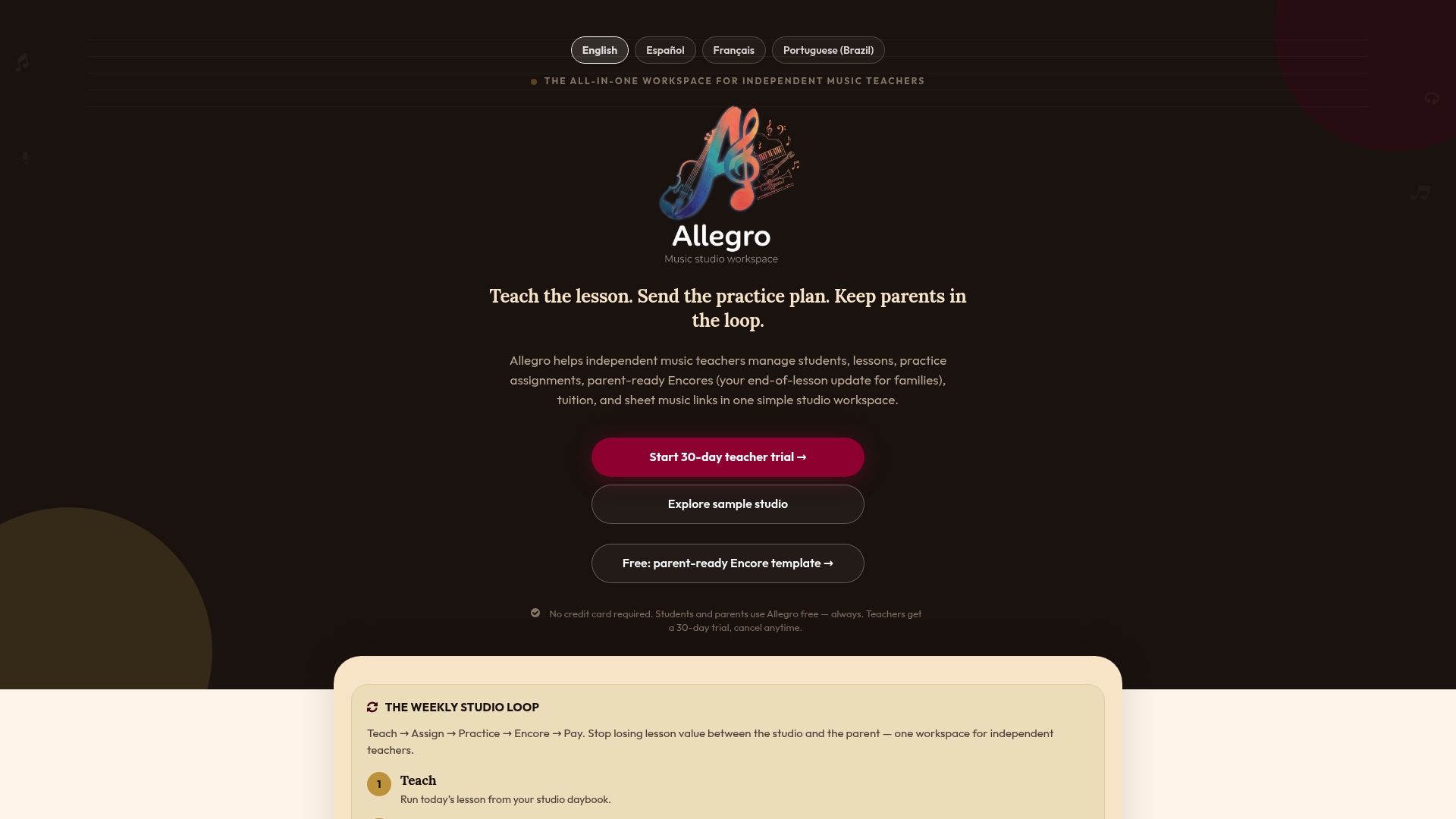
You can also look at a sample studio to see how a teacher’s workspace looks to families.
Frequently asked questions
Is it legal to charge 3% on credit card purchases?
In most U.S. states, yes, within limits. Visa allows a surcharge up to the lower of the card’s merchant discount rate or 3%, and some states prohibit or restrict surcharging. You must also give your processor 30 days’ notice and disclose the fee before payment. Confirm your state’s current rule first.
Can I charge parents extra for paying by debit card?
No. Merchants cannot surcharge debit or prepaid cards, even when a debit card is processed as credit. If you add a credit card surcharge, make sure your policy and payment setup apply it to credit cards only.
Do I have to tell my processor before adding a surcharge?
Yes, under Visa’s rules you must notify your acquirer at least 30 days before you start surcharging. You also need to disclose the fee where the family enters the payment process and show it as a separate line on every receipt.
What is the simplest way to avoid card fee conflicts?
Set tuition so processing costs are already included, state that in your studio policy, and repeat the payment terms on each invoice. With no surcharge, there is no cap to calculate, no state restriction to check and no extra line for a parent to question.
Sources
- Visa U.S. Merchant Surcharge Q&A
- Mastercard credit card surcharge rules for U.S. merchants
- Venable: Credit Card Surcharging, a Road Map for Platforms
- FTC: The Rule on Unfair or Deceptive Fees, FAQ
- Compliance checklist for parents and students