Public Domain Sheet Music Sites: 4 Picks Teachers Can Verify

For free, legal classical and jazz scores, start with IMSLP for the largest scanned library, Musopen for quick printable PDFs, the Mutopia Project for clean typeset editions, and Freed Jazz for public-domain jazz standards. Each site covers different ground, so always check the copyright tag or region note on a given score before you download or share it with students.
TL;DR:
- For U.S. downloads, check IMSLP’s regional tags or American mirror: its library follows Canadian law, so a listing may not qualify in the United States.
- A composition published in the United States before 1931 is generally public domain, but a newer engraving, preface, or editorial markings may remain copyrighted.
- Choose Musopen for quick printable PDFs; Mutopia’s more than 2,100 LilyPond editions include editable source files for transposing or simplifying student parts.
- Freed Jazz lists 52 jazz standards in the U.S. public domain; university and library archives are better places to search for rare historical scores.
Table of Contents
- 1. Reliable sites for public domain sheet music
- 2. How do you verify a score is actually public domain?
- 3. What formats you’ll find and how to use them
- 4. Where to find choral, jazz, and academic library scores
- 5. Practical tips for organizing scores you download
- 6. Why verification matters more than the search itself
- 7. Keep your score library connected to every lesson
- FAQ
- Sources
1. Reliable sites for public domain sheet music
Each of these repositories draws from a different part of the public-domain catalog, so knowing their strengths helps you pick the right one for a given piece or instrument.
- IMSLP is a large community-run library of scanned scores, strong for finding rare editions, first editions, and obscure composers.
- Musopen hosts a large, curated PDF collection with audio previews, good for quick downloads organized by composer and instrument.
- Mutopia Project offers volunteer-typeset editions built in LilyPond, ideal when you need a clean, editable file rather than an old scan.
- Freed Jazz focuses on U.S. jazz standards that have entered the public domain, filling a gap the classical-heavy sites leave open.
- Academic and library collections add depth for historical or rare material that community uploads rarely cover.
IMSLP functions as a large community library for public-domain music and aims to comply with Canadian copyright law, while offering guidance, including a PML-US mirror, to help American users navigate regional copyright differences. Its scope makes it the first stop for most searches: orchestral scores, chamber works, piano repertoire, and plenty of items you will not find typeset anywhere else, though quality varies since many files are decades-old library scans.
Musopen’s sheet music library states the site hosts over 100,000 classical sheet music PDFs available for free download, browsable by composer, instrument, period, and form. That browsing structure makes it a fast choice when you know exactly what you are looking for and want a clean PDF without digging through forum-style uploads.
The Mutopia Project offers more than 2,100 pieces typeset in LilyPond, which means you get both a polished PDF and the underlying editable source. That combination matters for a teacher who wants to retranspose a piece or simplify a passage for a younger student.
Freed Jazz maintains a dedicated collection of jazz standards that have entered the U.S. public domain, currently cataloging 52 tunes and expanding each year. For teachers working with jazz ensembles or vocal students, it fills a niche the classical-focused sites simply do not serve.
Beyond these four, library-run collections at institutions like Harvard, UCLA, and Brown add scanned historical material worth checking when a piece is rare or regionally specific.
2. How do you verify a score is actually public domain?
A piece being old does not automatically make every printed copy of it free to use. The National Association of Teachers of Singing explains that public domain status applies to the underlying composition, not necessarily to a specific printed edition, so a modern publisher can still hold copyright on a new engraving, fingering, or translation added to an old work.
- Check the composition date: music published in the U.S. before 1931 is generally public domain, while later works may still be under a 95-year term depending on authorship and renewal.
- Look for a region tag on the hosting site, since a score that’s public domain in one country can still be restricted elsewhere.
- Scan for publisher or plate numbers, prefaces, and logos, which often signal a modern, separately copyrighted edition layered over an old composition.
- Confirm whether the file sits on a region-specific mirror such as PML-US, which exists precisely because IMSLP’s main library follows Canadian law.
IMSLP’s own “Copyright Made Simple” page explains that a work is generally public domain in the U.S. if first published before 1931, while also flagging regional and edition-based exceptions that can complicate a simple date check.
Pro Tip: When a scan has a visible publisher logo, preface, or copyright notice printed on the page, treat it as a modern edition and look for an older or re-typeset alternative before distributing it.

3. What formats you’ll find and how to use them
Most repositories offer a few different file types, and picking the right one depends on what you plan to do with the score.
- PDF files are printable scans, the fastest option when you just need a copy to hand a student.
- LilyPond and MusicXML files are editable sources, best when you need to transpose a piece or adjust a part for a specific student’s level.
- MIDI files work as audio previews, handy for hearing a piece before committing to it for a lesson.
Editable sources are worth seeking out specifically when you need a student-friendly transposition rather than the original key. Some independent transcription tools also let you transpose and download clean, watermark-free PDF and MIDI files directly in the browser without creating an account, which can save time compared to editing a scanned PDF by hand. For printing, remember that U.S. Letter and A4 page sizes differ slightly, so check margins before printing a full set for a class, and only strip a publisher’s logo or preface page when the source explicitly allows it.
4. Where to find choral, jazz, and academic library scores
General repositories cover a lot of ground, but some needs call for a more specialized source.
- For choral music, look for sites that offer separated SATB parts rather than a single full score, since part extraction saves rehearsal time.
- Freed Jazz remains the clearest option for U.S. public-domain jazz standards and lead sheets.
- Academic collections at Harvard, UCLA, Brown, and the Levy Sheet Music archive hold historical and rare pieces that rarely surface in community-uploaded libraries.
- A library scan generally comes with better provenance and editorial notes, so prefer it over a community upload when you need to confirm an edition’s history for a program note or research purpose.
5. Practical tips for organizing scores you download
A few habits make downloaded scores far easier to reuse across lessons and share with families without confusion later.
- Save the source site, URL, and copyright tag alongside each file so you can reference it later in lesson notes or parent updates.
- Favor editable typeset files when you plan to create a student-specific transposition or a simplified part.
- Sort your library by composer, instrument, and skill level so you can link directly to a piece from a lesson plan.
- Only strip a logo or proprietary page when you have the right to do so, and keep a note of the original edition’s provenance.
Pro Tip: Build a simple folder structure by instrument and level before you start downloading, since retrofitting an organized system after files pile up takes far longer than setting it up first.
6. Why verification matters more than the search itself
Reliable repositories save real prep time. I’d rather spend time confirming a score’s status than later explaining to a parent why a piece got pulled from a recital program. The sites above do the heavy lifting of hosting public-domain material, but the date check and region tag are still yours to confirm. Keeping a short source note in your lesson summary protects you and gives families a clear record of where each piece came from.
— Dave
7. Keep your score library connected to every lesson
Once you’ve found and verified a score, the harder part is often remembering where you saved it and what you told a student to practice from it. We built Allegro so teachers can attach a score link directly to a lesson note, add practice instructions for a specific passage, and send a parent-ready Encore that summarizes what was covered and what comes next.
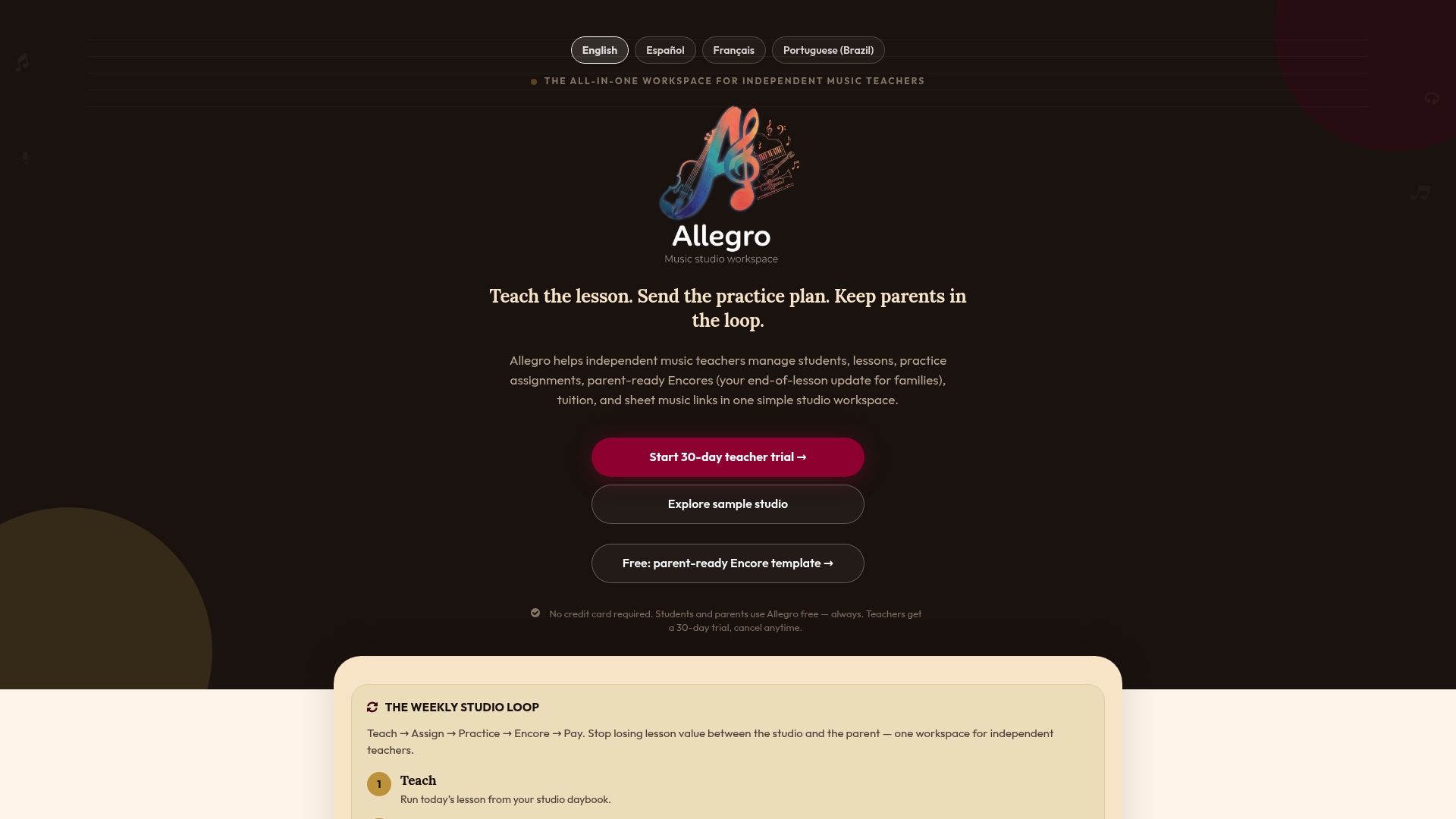
- Attach a public-domain score link to any lesson note so students and parents always know exactly what to practice.
- Track which pieces a student has worked through across weeks without digging through old emails or texts.
- Send parent-ready Encores so families see progress without you writing a separate summary by hand.
If you want to see how this fits into your own studio routine, our Solo and Studio plans both let you link scores, notes, and tuition tracking in one place, and Studio runs $39 per month. For teachers planning to re-engrave or typeset their own clean student editions from editable sources, Alhora offers formatting tools built for exactly that kind of print-ready output.
FAQ
Is IMSLP legal to use in the United States?
IMSLP primarily follows Canadian copyright law, so a score listed as public domain there is not automatically clear in the U.S. Check the region-specific tags or the PML-US mirror before downloading, since laws differ between Canada, the U.S., and the EU.
What’s the easiest site for quick printable PDFs?
Musopen hosts over 100,000 classical sheet music PDFs organized by composer, instrument, period, and form, making it a fast choice when you need a clean printable copy without extra formatting work.
Can I edit or transpose a public domain score for a student?
Yes, if you start from an editable source like the LilyPond and PDF files on the Mutopia Project, which offers over 2,100 typeset pieces built for exactly this kind of editing. Scanned PDFs from other sites are harder to modify directly.
Where can I find public domain jazz standards?
Freed Jazz catalogs jazz standards that have entered the U.S. public domain under the 95-year rule, currently listing 52 tunes and adding more each year. It is a dedicated source for this specific repertoire.
Does a public domain composition mean every edition of it is free to use?
No, a modern printed edition can carry its own copyright on added prefaces, logos, or editorial markings even when the underlying composition is public domain. Always check for a publisher’s notice or plate number before assuming a specific PDF is free to redistribute.