Swap List Policy for Music Teachers: Rules and Sample Wording

A swap list policy lets families trade lesson times with each other instead of asking you for make-ups. Parents opt in, arrange the exchange among themselves, tell you before and after, and your schedule stays inside your regular teaching hours. Below you will find the rules worth setting, real examples from working studios, and wording you can adapt.
This is about lesson-time swaps in a private music studio. If you searched “swap list policy” and landed on financial regulation or programming, this page is for the teacher’s version.
TL;DR
- A swap list is an opt-in arrangement where families exchange lesson slots with each other. You approve the change but do not do the matchmaking.
- Set five things in writing: who can request, how much notice, how many swaps per year, what happens if two students show up, and what happens to payment.
- Published studio policies use anywhere from 24 hours’ notice to five business days, and one caps swaps at four per student per school year.
- Parents, not students, should arrange swaps, and you should hear about every swap before and after it happens.
- Put the policy in your enrollment paperwork and repeat the confirmed swap in a short family update so nobody turns up at the wrong time.
Table of Contents
- What a swap list is and when it helps
- Why a clear policy protects you
- The five rules every swap list policy needs
- Copy-ready swap list policy wording
- Communicating swaps so nobody shows up at the wrong time
- Common problems and how to handle them
- Our perspective on swap lists
- Keep swaps, notes and tuition in one workspace
- FAQ
- Sources
What a swap list is and when it helps
A swap list is a short roster of families who agree to trade lesson times when one of them has a conflict. A child has a dentist appointment, a family is out of town, or a student is sick but will be better by next week. Instead of you hunting for an open slot, the family finds another family who can take their time and offers theirs in return.
Music teachers use swap lists as an alternative to make-up lessons for exactly these conflicts. The appeal is simple. A make-up lesson adds a teaching hour that was never in your week. A swap moves two existing hours around and leaves the total unchanged.
A swap list is most useful when:
- You teach a fixed weekly schedule with few open gaps.
- Your students are school-age, with predictable but frequent conflicts.
- You want to say yes to families more often without giving up evenings or weekends.
- You are tired of fielding one-off scheduling texts all week.
It is less useful for a very small roster, where there may be nobody to swap with, or for teachers with highly varied lesson lengths, where a 30-minute slot cannot easily trade with a 60-minute one.
Why a clear policy protects you
Teachers who skip the policy tend to renegotiate the same question every week. One teacher’s account of building her attendance rules argues that a clear attendance policy can help prevent teacher burnout. She describes her switch list as a central piece: parents arrange the switches, which keeps her within her regular teaching days.
Another teacher educator makes a related point: you should protect your family time, free time and personal life when you set your schedule. A swap list is one of the few scheduling tools that does that and still feels generous to families.
The swap list also fits alongside a broader makeup approach. If you want to pair it with a credit system for lessons you cancel yourself, our guide to makeup policies with 30-day credits covers that side.
The five rules every swap list policy needs
A good policy answers five questions before anyone asks them.
1. Who can request a swap
Make participation optional. One published studio policy has parents opt in through an agreement form, and families who opt in agree to share their phone number, email and lesson time with other participating parents so swaps can be scheduled. Opting out should carry no penalty.
Second, make the parent the requester, not the student. Younger students should never be negotiating times with other families, and older students can still have a parent copied. The parent arranging the swap emails you with the details and copies the other family, which also leaves a written record.
Third, state that swaps are reciprocal and voluntary. One studio’s policy says swaps are reciprocal, not obligatory, and families should respect a “no”. That sentence heads off a lot of awkwardness between families who may know each other from school.
2. How much notice you need
Notice periods in published policies vary quite a bit, and the right number depends on how you see your schedule.
| Studio | Notice rule | Other limits |
|---|---|---|
| Statz Music Studio | At least 24 hours before the first swapped lesson, and the teacher is informed within 24 hours after the swap is arranged | Four swaps per student per school year |
| Academy of Sound, Oregon, WI | At least five business days in advance, subject to availability (2026-2027 school year policy) | Subject to availability |
A short window such as 24 hours suits a teacher who keeps a flexible day and checks messages often. A five-business-day window suits a teacher with a busy school-based program who needs lead time. Pick the one that matches your real habits, because a rule you enforce inconsistently is worse than a stricter rule you keep.
A middle path is to set a standard notice period and add a line for emergencies: same-day sickness is not a swap, it is a missed lesson, and it follows your missed-lesson rules instead.
3. How many swaps per year
Without a cap, a few families will use the swap list every month and the rest never will. A cap keeps the habit fair and keeps your week predictable. One studio limits swaps to four per student per school year. You might choose one per month, or two per term. Whatever you choose, say whether the cap counts requests or completed swaps.
4. Who gets the lesson if two students show up
This is the scenario that makes teachers write a swap policy in the first place. Two children arrive at the door for the same slot, each convinced they are right.
The simple rule used by published policies: the teacher teaches the student normally scheduled for that time. The teacher must be asked before a swap and informed after it is arranged, so the burden of confirming the swap is on the families, not on you. One studio adds that no make-up is given if confusion arises from a swap. Both rules are easy to explain, and neither requires you to referee.
5. What happens to payment
A swap should never change what a family owes. Tuition covers a place in your schedule, and the swap simply moves where in the week that place sits. Say so plainly.
For context, one studio’s policy states that missed lessons receive no refunds, discounts or make-ups unless the studio cannot teach the promised number of lessons. Your policy does not have to be that strict, but it should be as explicit. If you also charge late fees, keep the wording consistent with your swap rules, and see our late fee wording for a version you can copy.
Copy-ready swap list policy wording
Adapt the numbers to your own studio. This is a template, not a legal document, so have a local professional review it if you run a larger business or have contracts with schools.
Lesson swap list. Our studio keeps an optional swap list for families who would like to trade lesson times with each other. By opting in on your enrollment form, you agree to share your name, email, phone number and regular lesson time with other families on the list. Opting out has no effect on your lessons.
How swaps work. A parent or guardian, not the student, arranges the swap with another family on the list. Please email me the details of the swap and copy the other family at least [24 hours / five business days] before the first swapped lesson. I must approve it before it happens, and a swap is not final until I reply.
Limits. Each student may swap up to [number] times per [school year / term]. Swaps are voluntary for both families, and a “no” to a request should be respected.
Confusion at the door. If two students arrive for the same time, I will teach the student originally scheduled for that slot. No make-up lesson is offered when a mix-up comes from a swap.
Tuition. Swapping does not change tuition. A swap is a change of time, not a cancellation, and no credit or refund is created.
Keep the tone friendly but firm, which is the approach one teacher educator recommends for communicating studio policies. Families generally accept clear rules when they are written warmly and applied evenly.
Communicating swaps so nobody shows up at the wrong time
Most swap disasters are communication failures, not policy failures. A few habits prevent them.
Give the policy a home. Put it in your enrollment packet and your studio handbook, and offer the opt-in as a checkbox on the agreement form. Our onboarding templates show where that fits in a new-family welcome.
Confirm in writing, every time. When a parent emails you a proposed swap, reply with one line: the original time, the new time, the date, and who is swapping with whom. The other family is already copied, so everyone sees the same confirmation.
Use one channel. If some families text, others email and a few message you on social media, you will lose swaps in the gaps. Choose one channel for scheduling and say so in the policy. Our guide to parent communication boundaries includes wording for this.
Mention the swap in the lesson update. When a swapped lesson happens, the family should see it reflected in their regular recap, so the record of what was covered and what to practice is never tied to a particular time slot. If you want a lightweight routine for those recaps, try the three-step parent communication method.
Handle remote lessons separately. If you move a lesson online when a student cannot attend in person, that is a format change, not a swap. A clear remote lesson communication plan keeps the two ideas apart.
Common problems and how to handle them
A family always asks and never offers. Reciprocity is the whole idea. If one family keeps requesting swaps and never takes an inconvenient slot, the cap will usually resolve it. You can also gently remind them that swaps are voluntary for the other side.
Two families agree but you were not told. The policy should say a swap without your approval is not a swap. The student scheduled for that slot gets the lesson, and no make-up applies.
The swap list is too small to work. Under about ten or twelve families, matching is hard. In that case, offer swaps within a cluster of students on the same day and combine the list with a limited make-up option.
Families share contact details without consent. This is why opt-in matters. Only share details of families who agreed in writing, and consider whether a simple list with first names and lesson times is enough.
Lessons of different lengths. Say that swaps are only between lessons of the same length, or let you decide case by case.
Your schedule is full of back-to-back students. A swap that moves a student into the slot before or after a break can wreck your own breaks. Reserve the right to decline swaps that affect your planned break or transition time.
If organization is the underlying problem, our eight steps to music studio organization will help you tidy the scheduling side before you add a swap list.

Our perspective on swap lists
We built Allegro for independent teachers who are stretched across lessons, parent messages and billing, and swap lists come up constantly in what they tell us. The idea works because it moves a small chore, finding a replacement time, to the people who benefit from it. The danger is that the swap itself becomes one more thing you have to track.
Our view is that the policy matters less than the paper trail. Whatever rules you choose, three things should always be true: the family knows what the rule is, you know what time each student is coming, and the family can see afterwards what the lesson covered and what to practice next. A swap should never make a lesson less useful.

That last point is why we focus on lesson notes and parent-ready summaries rather than scheduling alone. If a student swaps into a different day, the recap that goes home is still the same: what happened, what to practice, and what comes next. Families judge a studio less by how flexible it is and more by whether progress feels visible, and a clear update after each lesson does more for retention than any scheduling concession.
Start with a modest policy, apply it evenly for a term, and then adjust the notice period or cap based on what actually happened.
— Dave
Keep swaps, notes and tuition in one workspace
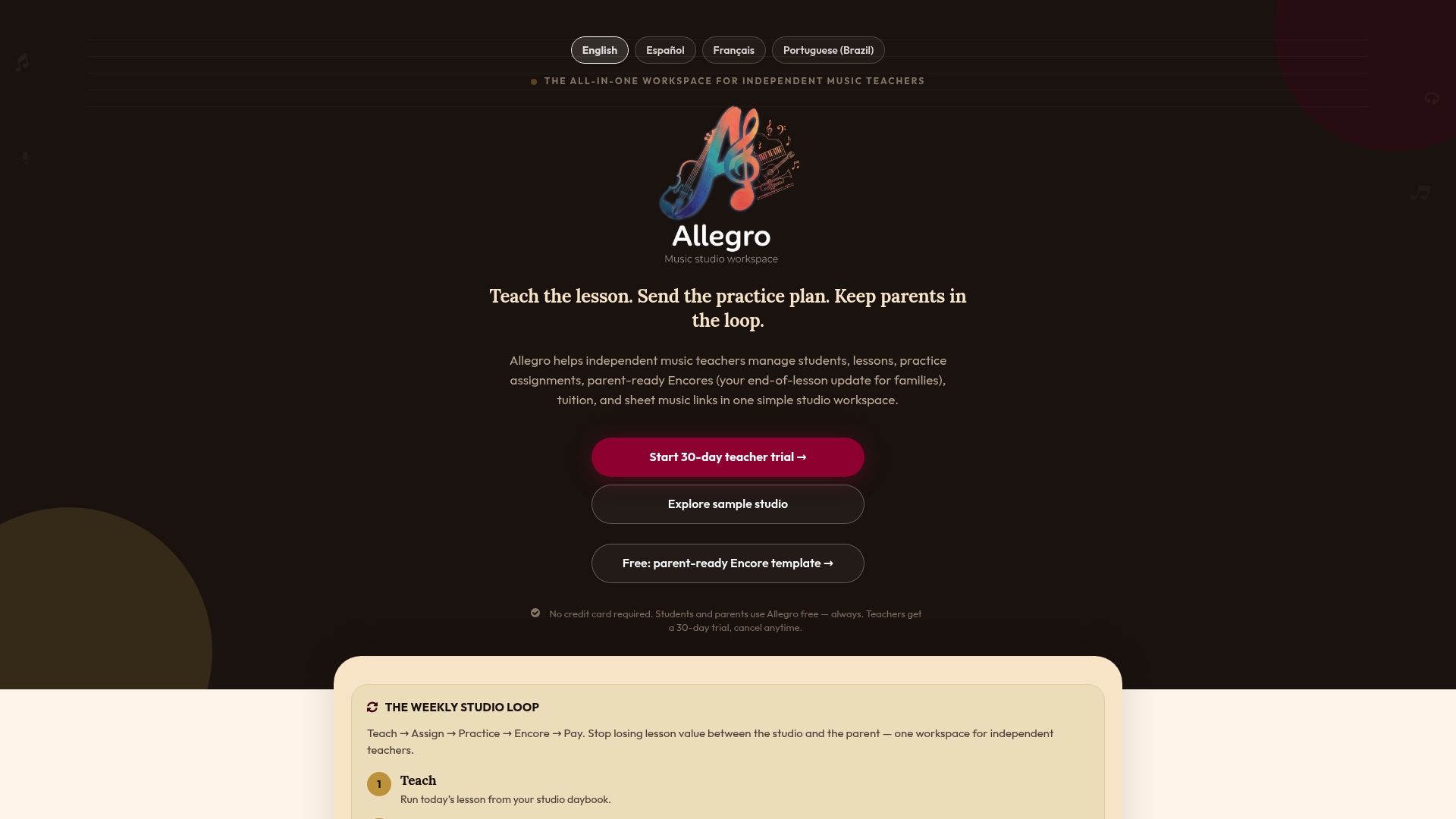
Allegro is a workspace for independent music teachers that brings students, lessons, digital lesson notes, practice assignments, family communication and tuition tracking together. Instead of searching through email threads to find which family swapped with whom, you keep the lesson record, the practice plan and the parent-ready Encore summary in one place. Students and parents use Allegro free of charge.
The Studio plan is listed at $39 per month, and there is a Solo plan as well. Teachers can start with a 30-day trial. You can look at a sample studio to see how an Encore reads for a family, or compare the Solo and Studio plans when you are ready.
If you want to try the policy ideas first, our free templates for studio policies and parent communication are a good starting point before you subscribe.
FAQ
Should a swap list be optional?
Yes. Make it an opt-in checkbox on your enrollment or agreement form, as one published studio policy does. Families who opt in agree to share their contact details and lesson time with other participating families, and those who decline lose nothing.
How much notice should I require for a swap?
Published policies range from 24 hours to five business days. Choose the shorter window if you are flexible and check messages daily, and the longer one if you need lead time to plan your teaching day.
Do swaps count as make-up lessons?
No. A swap moves a lesson to another existing slot and does not add teaching time to your week. It also should not change tuition. Treat make-up lessons or credits as a separate policy for lessons that you cancel or that families miss.
What if two students arrive for the same time?
Teach the student who is normally scheduled for that slot. That is the rule in published swap policies, and it works because the families are responsible for asking you before the swap and telling you after.
Can students arrange swaps themselves?
It is safer to require a parent or guardian to arrange them. The parent emails you the details and copies the other family, which creates a written record and keeps children out of scheduling negotiations.
Sources
- To Give or Not to Give Make Up Piano Lessons
- Dueling Students at My Door: Time for Swap List Rules
- Piano Student Attendance Policies That Avoid Teacher Burnout
- Statz Music Studio missed lesson policy
- Academy of Sound policy, Oregon, WI