Cashless Studio Policy: Wording, Legality and Rollout

A cashless studio policy is a short, written rule in your studio agreement: tuition is paid electronically, by the methods you name, on the dates you set. In most of the US that is legal for a private music teacher. A handful of states and cities require in-person businesses to accept cash, though, so check your own location before you publish the policy. This guide covers the legal picture, the wording, how to announce the change, and how to keep families who struggle with electronic payments on board.
TL;DR
- No federal law requires a private business to accept cash, so a cashless studio is usually allowed unless state or local law says otherwise.
- Connecticut, Massachusetts, New Jersey, Rhode Island, Washington, D.C., Philadelphia and some cities (San Francisco, for example) protect cash payments. Check your own jurisdiction before you write the policy.
- A good policy names the payment methods, due date, late and failed-payment rules, and what happens to a lesson slot when a payment bounces.
- Tell families early, in writing, with a clear start date and one simple way to pay.
- Plan for families without bank access, and keep every payment tied to a lesson record so billing stays organized.
Table of Contents
- Is a cashless music studio legal?
- Where cash acceptance is required
- Why teachers go cashless
- What a cashless studio policy should say
- How to tell students and parents
- Families who can’t easily pay electronically
- Perspective: why we put payments next to lesson notes
- Run it from one workspace
- Keeping billing and records organized after the switch
- FAQ
- Sources
Is a cashless music studio legal?
In most places, yes. The Federal Reserve states that no federal statute requires a private business to accept currency or coins, and that private businesses may set their own cash policies unless state law says otherwise. The “legal tender” language in federal law concerns debts, not what a shop or a teacher must take at the door.
State law is where it gets specific. Georgia’s Attorney General’s consumer protection division said in 2021 that Georgia has no statute requiring businesses to accept cash, so a Georgia business could refuse cash for goods or services. Other places go the opposite way, covered next.

Where cash acceptance is required
These rules change, so treat this list as a map of where to look, not as legal advice. Confirm the current text with your state consumer protection office or a local attorney.
| Place | What the rule says | Where it stops |
|---|---|---|
| Connecticut | In-person retail sellers of goods or services generally may not refuse cash, post cashless signs, or charge cash customers more, according to the Department of Consumer Protection. | Exceptions exist, including a qualifying cash-to-prepaid-card device. |
| New Jersey | A person selling goods or services at retail must accept legal tender, under N.J. Rev. Stat. 56:8-2.33. | Telephone, mail and Internet transactions are excluded. Civil penalties run up to $2,500 for a first violation and $5,000 for a second. |
| San Francisco | Covered brick-and-mortar businesses must accept cash, per Article 55 of the Police Code. | Applies to fixed-premises businesses; exceptions are listed separately. |
| Newport Beach, CA | Covered businesses must accept cash for consumer services when the customer is physically present, under Chapter 5.98. | Exceptions include suspected counterfeit bills, notes over $50, transactions above $5,000 and remote transactions. |
| West Hollywood, CA | It is unlawful for a customer-facing business with a physical location in the city to refuse cash, under Chapter 5.126. | Violations fall under the city’s administrative-penalty rules. |
A Maine Legislature research memo also lists Massachusetts, New Jersey, Rhode Island, the District of Columbia, Philadelphia and specified municipalities as having enacted cash-acceptance protections. Whether a given law reaches a music teacher depends on how that jurisdiction defines “retail” and what it exempts.
How this applies to a lesson studio
Three questions decide it for you.
- Do you sell in person? Laws such as Newport Beach’s focus on a customer physically present at a business with a fixed location. Tuition billed by emailed invoice and paid online is a different kind of transaction. New Jersey’s statute, for one, excludes telephone, mail and Internet transactions.
- Do you teach from a commercial space, a home studio or the student’s home? Local definitions of a covered business often hinge on a physical storefront.
- Who is responsible? In Newport Beach, compliance falls on the business owner, not on an employee or contractor. Independent teachers who rent room time in a larger school should ask the school what its policy is.
If you teach in one of the places above and take payments at the lesson itself, ask your city or state consumer office before you print “no cash” on anything. If you invoice online ahead of the month, you are usually on firmer ground, but confirm it.
Why teachers go cashless
The reasons are mostly about time and records, and the Federal Reserve’s research on cashless businesses backs up part of the case. It notes that cashless businesses eliminate cash-handling costs, reduce theft opportunities and can speed up transactions.
For a teacher, that translates into:
- No envelopes in the music bag. Cash gets forgotten, lost or handed over mid-lesson when you should be teaching.
- A record for every payment. Card and online payments leave a timestamped trail, which settles any “I already paid” conversation quickly.
- Fewer awkward reminders. Automatic monthly billing means you are not the one asking.
- Cleaner books at tax time. Every payment sits next to the student and month it belongs to.
A flat monthly rate makes all of this simpler. If you still bill lesson by lesson, our guide to flat-rate tuition for music studios shows how to turn a per-lesson price into a predictable monthly amount.
What a cashless studio policy should say
Keep it to one page, plain language, and put it where families sign. Private-lesson contract guidance generally says the policy should state lesson fees, accepted payment methods, payment frequency, late fees, and whether families receive invoices. Beyond that, cover these points.
1. Accepted payment methods
Name them exactly. Real studio policies show the range: one Massachusetts studio makes ACH transfer its default method, allows cards with a 3% fee and does not accept cash, checks, Venmo or PayPal. A Texas studio charges a 2.95% processing fee on major cards and offers bank draft with no processing fee. Whatever you choose, say which methods are free to the family and which carry a fee.

2. Billing schedule and due date
State whether you bill monthly, per lesson or in prepaid blocks such as a semester, and give an exact due date. One studio bills automatically on the first of each month and charges a $10 late fee for non-auto-pay students whose payment arrives after the 10th. Use your own numbers, but copy the clarity.
3. Late and failed payments
Say what happens, in order: reminder, late fee, pause of lessons, release of the slot. Another studio reserves the right to collect returned-item, rejection, chargeback or insufficient-funds fees to the maximum extent permitted by law. Check your state’s limits on fees before you set an amount. For ready wording, see our late fee wording for music teachers.
4. Cash exception, if you want one
You can write “We do not accept cash” or you can add “Families who cannot pay electronically should contact us to arrange another method.” The second version keeps goodwill, and in a place with a cash-acceptance law it may be the safer choice.
5. Receipts and records
Promise a receipt or invoice for every payment. It protects the family and you.
Sample wording
Tuition is billed on the 1st of each month and is due by the 5th. We accept ACH bank payment and major credit or debit cards through the secure payment link on your invoice. We do not take cash or checks at lessons. If paying electronically is a barrier for your family, talk to us before the due date and we will find a workable option. Returned payments and any bank fees are the responsibility of the account holder.
For invoice-specific phrasing, our invoice wording examples and template can be pasted straight into your billing emails, and the same page of policies fits into the student onboarding templates you send to new families.
How to tell students and parents
Families accept a change they understood early and a change that has one clear next step. A simple rollout:
- Give notice. Send the new policy at least a full billing cycle before it starts, so no one is surprised at a lesson.
- Say why in one sentence. For example: it keeps tuition records accurate and frees lesson time for music.
- Give the start date and the first payment due date. Put both in the subject line.
- Show how to pay. Include the link or the steps in the same email, with a screenshot if you can.
- Invite questions. Offer a short window, by email or after a lesson, for anyone who needs help.
- Confirm in writing. Ask parents to reply “agreed” or sign the updated policy.
Keep the tone matter-of-fact. The message is about how tuition is handled, not about anyone’s habits. Our parent communication boundaries guide covers how to keep these messages short, consistent and inside the hours you choose.
Families who can’t easily pay electronically
This is the real cost of a strict no-cash rule. The Federal Reserve’s research reports that 6.5% of US households were unbanked in 2017 (8.4 million) and 24.2 million were underbanked, and notes that cashless policies can leave these consumers out. In a studio of 20 to 40 families, you may well have one or two in that situation.
Practical ways to handle it while staying organized:
- Offer more than one electronic route. A family without a credit card may be able to use a debit card, a bank transfer or a prepaid card. Listing two or three methods covers most households.
- Make the payment link easy. A link on the invoice that opens on a phone, with no account required, removes most of the friction.
- Allow a quarterly or semester block. Fewer payments can be easier for a family that has to go to a store or bank to complete each one.
- Write a contact-us line. Families will not ask for help if the policy sounds closed. Invite the conversation.
- Record every payment the same way. Whatever arrangement you reach, log it against the student and month so your records stay uniform.
If you are in a cash-acceptance jurisdiction, this question is not optional, so ask your local consumer office what is expected.
Perspective: why we put payments next to lesson notes
We built Allegro for independent teachers who are tired of running a studio across texts, notes apps and spreadsheets. Payment is the clearest example. When tuition lives in one place and the lesson notes live in another, every payment question turns into a search.
Our view is simple: the conversation with a family should be about the student’s progress, and billing should fade into the background. That is why tuition tracking, invoices and payment links sit in the same workspace as lessons, assignments and Encores, the parent-ready summaries that show what happened and what to practice next.
A cashless policy works best when the rest of the system is calm. A parent who just read a clear Encore is far more relaxed about an invoice that arrives the same week. We would rather you spend your energy on teaching than on chasing envelopes.
Dave
Run it from one workspace
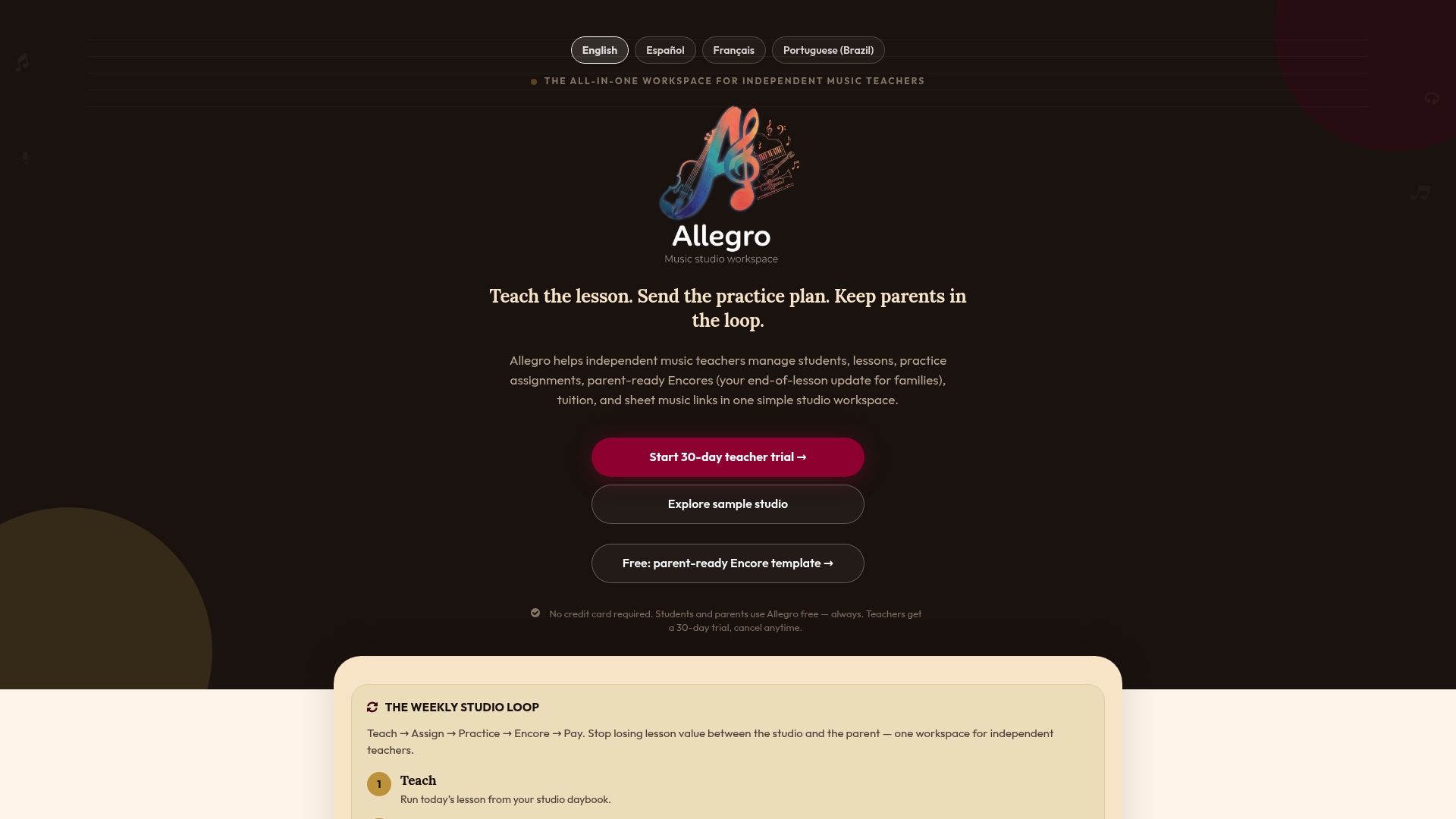
Allegro brings students, lessons, digital lesson notes, practice assignments, Encores, tuition tracking with invoices and payment links, and family communication into one place. Parents and students use it free of charge. You start with a 30-day trial, and the Studio plan is $39 per month. See the plans on the Allegro home page.
If you want to see how invoices and payment links work together first, read our guide to secure payment links in invoices. To tidy the rest of your admin at the same time, work through the eight steps to studio organization.
Keeping billing and records organized after the switch
A cashless studio only pays off if the paperwork follows. A weekly routine of ten minutes does it:
- Check which invoices are paid, pending or failed.
- Send reminders for anything past due, using the same wording every time.
- Match each payment to a student and a lesson month.
- Note any special arrangement in the family’s record, not in your memory.
- Once a month, export or review the totals so tax time holds no surprises.
If you offer family pricing, spell it out in writing too. Our sibling discount policy page shows copy-ready rules so discounts do not cause billing confusion. And when parents ask how a child is doing, a student progress checklist gives you something concrete to point to.
FAQ
Can a music teacher legally say “no cash”?
Usually yes. There is no federal requirement for private businesses to accept cash, according to the Federal Reserve. Some states and cities, including Connecticut, New Jersey, San Francisco and Newport Beach, require in-person businesses to take it, so check your own location first.
Does a cash-acceptance law apply if I invoice online?
It depends on the law’s wording. New Jersey’s statute, for example, excludes telephone, mail and Internet transactions, and Newport Beach’s rule applies when the customer is physically present. Ask your state consumer protection office how your jurisdiction treats invoiced tuition.
Which payment methods should a cashless studio accept?
Most studios list one low-fee bank method, such as ACH, plus cards. Decide which carries a processing fee and say so in the policy. Offering at least two methods helps families who lack one of them.
How much notice should I give before switching?
A full billing cycle is a sensible minimum, with the policy in writing, a start date and instructions for paying. Longer is kinder if you have many families new to online payments.
What if a family can’t pay electronically?
Invite them to contact you before the due date and agree an alternative, such as a different electronic method or a prepaid block. Log the arrangement in their record. In places that require cash acceptance, you must take cash.
Sources
- Federal Reserve: Is it legal for a business to refuse cash?
- Georgia Consumer Protection: Can businesses refuse cash payments?
- Connecticut Department of Consumer Protection: Cash Payments
- New Jersey Revised Statutes 56:8-2.33
- San Francisco Police Code, Article 55
- Newport Beach Municipal Code, Chapter 5.98
- West Hollywood Municipal Code, Chapter 5.126
- Maine Legislature: State and municipality cashless ban legislation
- Federal Reserve Financial Services: Cash Me If You Can
- Creating a Private Lesson Contract for Your Studio
- Mindful Music Studio: Tuition
- Rockstars of Tomorrow: Policies, Frisco
- Ztunes: Policy
- Sage Music: Student Policies