Lesson Observation Notes: Four Fields to a Practice Plan and Recap

A useful lesson observation note captures four fields: the pieces worked on, a genuine gain, a specific obstacle, and clear practice instructions. Together they turn a lesson into a concrete, usable practice plan instead of a vague memory. Tools like Allegro Music Studio build this structure into the lesson-closing routine so teachers spend less time writing and more time teaching.
TL;DR:
- Name the piece, section, and tempo, then record one observable gain, one obstacle with its likely cause, and a measurable practice task.
- Keep notes actionable rather than transcribing lessons; capture the headline and obstacle during class, then dictate instructions or attach a short demonstration recording.
- Translate notes into a brief parent recap with one piece, one gain, and one next step, while keeping diagnostic details internal and practice tasks explicit.
- Ask students what felt hardest or most secure, and add their answer; reflection can reveal overlooked obstacles and strengthen independent practice habits.
- For intermediate passages, start at 50% of target tempo and add 10 bpm after each successful run; performance preparation includes two or three mock performances.
Table of Contents
- What to record: four fields that make a note useful
- How to write lesson notes fast without losing detail
- Turning a note into a practice plan and a parent recap
- Templates you can copy today
- Bringing the student’s own voice into the note
- Why short, repeatable notes scale across a studio
- Put this into practice with Allegro
- FAQ
- Sources
What to record: four fields that make a note useful
Every field earns its place because it answers a question the next lesson, or the next practice session, will ask. Skip one and the note turns into a diary entry instead of a plan.
- Pieces worked on: name the title, composer, the measure range or section, and a tempo target, such as “Clair de Lune, mm. 1-8, quarter note at 60 bpm.”
- Genuine gains: record one specific improvement, not a general compliment. “Left-hand legato in mm. 12-16, steady eighths at 60 bpm” tells a parent and a future you exactly what changed.
- Specific obstacles: name the problem and its likely cause. “Rushes the triplet in m. 9, probably a fingering substitution” is something you can fix next week. “Needs more practice” is not.
- Clear practice instructions: give a precise task with a measurable target. “Slow practice at 60 bpm, hands separate, eight repeats with a four-count pickup, record and send a demo” leaves no room for guessing.
Each field matters because a lesson note is really two documents at once: a record for you and a cue sheet for the student’s week. The pieces field keeps repertoire tracking consistent across months, which matters when you are juggling dozens of students and need to see at a glance where each one left off. A repertoire-tracking system that logs measure ranges over time makes it obvious when a passage has stalled for three weeks running.
The gains field does double duty. It gives the student something concrete to feel good about, and it gives you a baseline to compare against next time. The obstacles field is the diagnostic heart of the note: naming a probable cause, rather than just a symptom, is what lets next week’s lesson start with a fix instead of a repeat of the same correction. And the practice instructions field is the only part of the note a student actually acts on between lessons, so vague language there wastes the other three fields.
How to write lesson notes fast without losing detail
A repeatable structure beats a blank text box every time, because it removes the decision of what to write and leaves only the content.
- Write a one-line headline: piece plus section, such as “Minuet in G, mm. 9-16.”
- Add one line naming the gain in concrete terms.
- Add one line naming the obstacle and its likely cause.
- Close with a two-line practice plan: what to do, at what tempo, how many repeats.
A short, consistent vocabulary speeds this up further. Verbs like “secure,” “isolate,” “repeat,” “record at,” and “use metronome at” do the work of a full sentence in two or three words, and they read the same way every week, which makes notes easier for parents to parse over time.
Shorthand and attachments save the most time. Jot the headline and obstacle during the lesson, then dictate the practice plan while the student packs up. Attaching a short audio or video demo instead of writing out a description is often faster and far clearer for the student to imitate. Batch-recording demo videos between lessons, rather than one at a time, keeps this from eating into your day.
The biggest trap is writing a transcript of the lesson instead of a note. A transcript describes what happened; a note changes what happens next. If a line in your note does not affect the next lesson or the next practice session, cut it.
Pro Tip: Keep a short list of five or six standard phrases, like “steady eighths,” “hands separate,” and “secure the fingering,” so every note reads the same way to a parent scanning it quickly.
Turning a note into a practice plan and a parent recap
A lesson note only pays off once it becomes something the student can act on and a parent can understand without a music degree. That conversion is where a platform like Allegro Music Studio earns its place in the routine: raw notes become an “Encore,” a short parent-ready summary of what the student learned and what to practice next.
- The pieces field becomes the Encore’s subject line: “Working on Clair de Lune, mm. 1-8.”
- The gains field becomes one encouraging sentence a parent can repeat at the dinner table: “Left-hand legato is noticeably smoother this week.”
- The obstacles field stays internal, shaping the next lesson, while a softened version (“still building rhythmic steadiness in the triplets”) goes into the parent-facing line.
- The practice instructions field becomes the student’s actual to-do list, often with a linked demo recording attached.
Teachers using a 1-1-1 structure for parent communication, one piece, one gain, one next step, report that families follow up more consistently because the message is short enough to read in the time it takes to glance at a phone. A unified workflow also cuts the admin load that comes from writing a lesson note in one app, a text to a parent in another, and a practice checklist on paper. Consolidating notes, assignments, demo links, and billing in one place removes that duplication.
A simple template helps here: leave a placeholder line for your signature, a line for the demo link, and a line for the next lesson date, so every Encore follows the same shape and nothing gets left out.
Templates you can copy today
A leveled template saves you from reinventing the note format for every student. These three cover most studio situations.
- Beginner (piano or guitar): scope to measures 1-8, goal is hands-together coordination, daily micro-task is two minutes of hands-separate repetition at a slow, fixed tempo.
- Intermediate (strings or winds): a passage practice plan with a tempo ladder (start at 50% target tempo, add 10 bpm per successful run), plus an aural-model assignment using a recorded demo.
- Performance prep: section-by-section targets, a schedule of two or three mock run-throughs before the date, and a recorded demo link for self-comparison.
Here is a raw note and its conversion. Raw note: “Sonatina, movement 1, still rushing the sixteenths in m. 24, left hand needs separate work, sounded better by the end.” Converted practice plan: “Isolate m. 24 at 50 bpm, hands separate, eight repeats; record left hand alone and send by Thursday.” Parent Encore line: “Making progress on the Sonatina opening, focusing on steady rhythm this week.” You can see more worked examples in these lesson-note templates for private teachers.
Bringing the student’s own voice into the note
A lesson note does not have to be entirely teacher-written. Asking a student to rate their own progress on a piece, or to name what felt hardest, adds a layer of self-assessment that sharpens both the note and the student’s awareness of their own playing. A structured practice journal that prompts a student to log tempo, repeats, and a short reflection has been shown to increase self-regulated practice strategies and self-efficacy in middle school string students, which suggests the habit of reflecting on practice, not just doing it, carries real weight.

A quick way to apply this: ask a closing question at the end of each lesson, such as “which part felt most secure today?” or “what would you grade yourself on this passage, and why?” Note the answer in a single line. For younger students, keep the question concrete (“was the left hand easy or hard today?”); for intermediate and advanced students, a sectional self-rating against a tempo ladder works well and ties directly into the obstacles and practice fields. Over a few weeks, these self-assessment lines build a second thread in the note that often surfaces obstacles the teacher missed, because the student felt something the ear in the room didn’t catch.
This habit also makes parent recaps more credible: an Encore that includes a one-line quote from the student’s own reflection tends to land better than teacher language alone, since it shows the student is an active participant rather than a passive recipient of instructions.
Why short, repeatable notes scale across a studio
The five-minute close only works if the note format never changes. Once you have to think about structure, you lose the time savings and the consistency that make notes comparable week over week across dozens of students.
Brevity is not a shortcut, it is the feature that makes the habit sustainable. A note built on four fields, backed by an audio demo, and closed with a one-line student reflection, does more for a student’s week than a long paragraph ever will. Try the aural and visual scaffolds described above for a month and watch whether obstacles shrink faster than they did before.
— Dave
Put this into practice with Allegro
Writing four-field notes is simple on paper, but keeping them consistent across a full roster, while also turning each one into a parent-ready Encore, is where most teachers lose time. We built Allegro Music Studio to hold lesson notes, practice assignments, demo links, and tuition tracking in one workspace, so the note you write at 4:45 PM becomes a parent recap without a second pass.
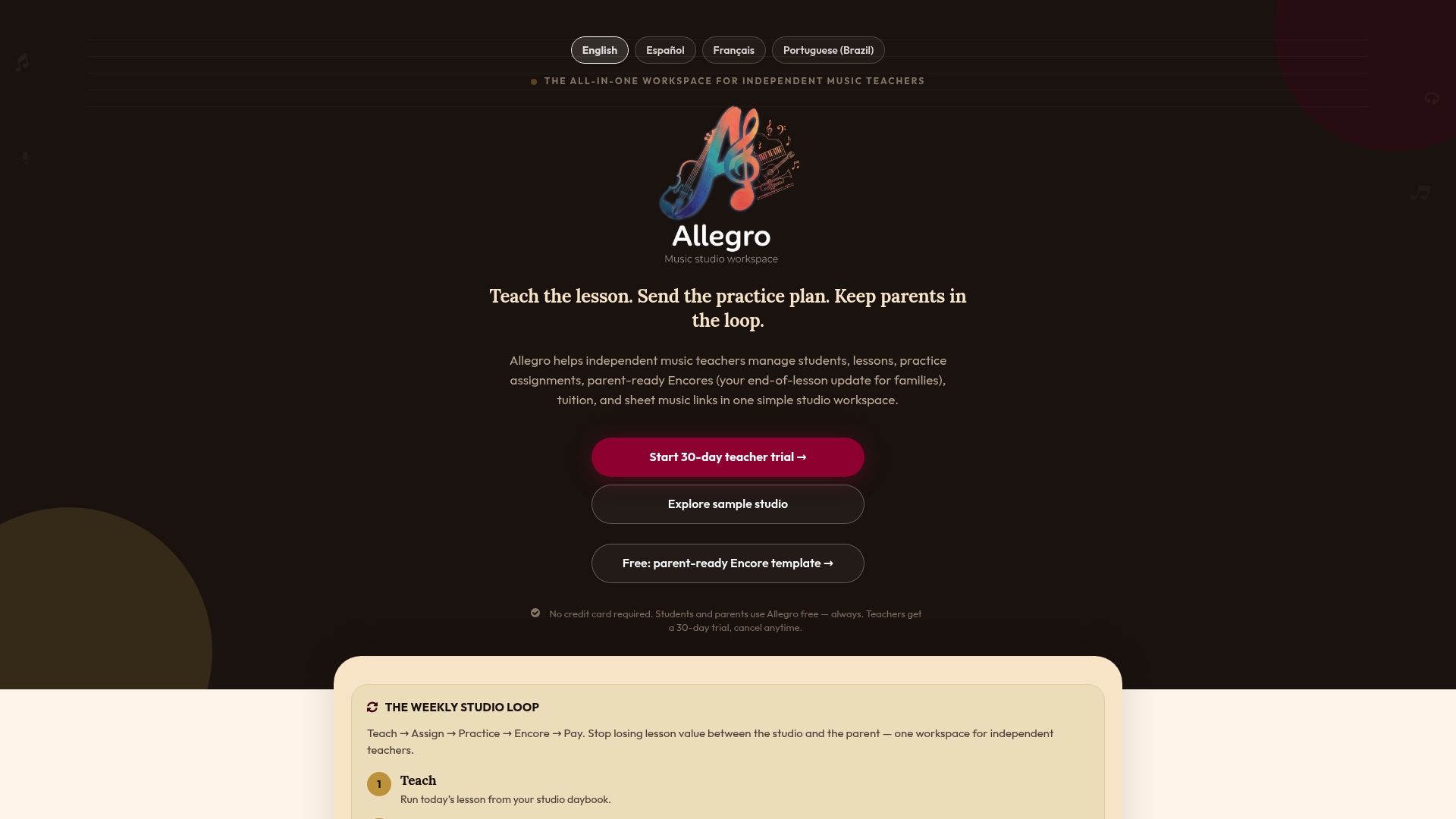
Our Solo and Studio plans are both built around this note-to-Encore workflow. Studio runs $39 per month with the full set of parent communication and tuition tools; Solo pricing is available on request. If you want to see the format in action first, our lesson-note examples and studio organization guide are free to copy before you ever start a trial. Beyond the templates, pairing structured notes with proven student motivation strategies can help the practice plan actually get used at home. Start a trial at Allegromusic and see how the next lesson note writes itself.
FAQ
What are the four fields every lesson note should have?
A useful note records the pieces worked on, one genuine gain, one specific obstacle with its likely cause, and clear practice instructions with a measurable target like tempo or repeat count. Leaving any field out tends to turn the note into a vague summary instead of a plan the student can act on.
How often should I write lesson observation notes?
Write one note per lesson, right at the close, while details are still fresh and before the next student arrives. Writing notes in batches later in the day or week tends to lose the specific obstacle details that make a note useful.
What should I avoid writing in a lesson note?
Avoid writing a transcript of everything that happened in the lesson. A 2019 study on aural and visual practice scaffolds found greater accuracy gains when students practiced with a clear aural target, which only works if the note states a specific, actionable task rather than a general description of the lesson.
How do I make lesson notes easy for parents to understand?
Convert the obstacle and practice fields into one or two short, plain-language sentences, similar to the 1-1-1 structure of one piece, one gain, one next step. Platforms like Allegro Music Studio automate this conversion into a parent-ready Encore so the teacher does not have to rewrite the note twice.
Can students help write their own observation notes?
Yes, asking a student to name what felt hardest or rate their own progress adds a self-assessment line that often surfaces details the teacher missed. Structured reflection has been linked to increased self-regulated practice strategies in middle school string students.
Sources
- Study: aural models and practice scaffolds improve accuracy (2019)
- Structured practice journals increase self-regulated practice (2019)